Best Garden Kneelers and Stools for Sore Knees UK (2025)
As an Amazon Associate I earn from qualifying purchases. This page contains affiliate links — if you buy through them, I earn a small commission at no extra cost to you.
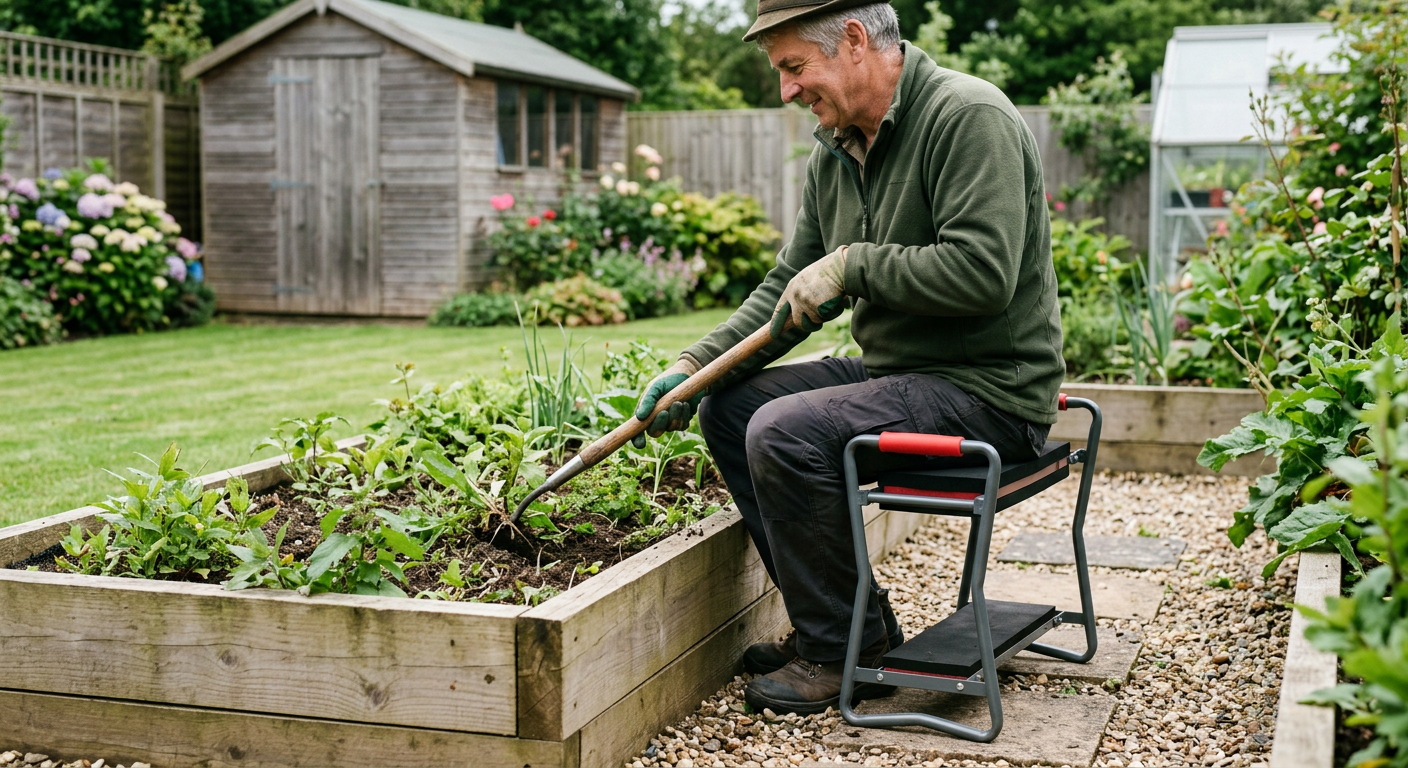
You’ve just slipped on wet grass, landed hard on a cheap foam pad, and the moment you try to stand up, your lower back snarls. That split‑second push upwards is the hidden culprit that turns a simple weeding session into a week of regret. A proper garden kneeler isn’t just about cushioning sore joints; it’s a mechanical lever that shifts the heavy lifting from your spine to your arms, keeping you gardening for longer.
Why do standard garden knee pads fail (and what should you use instead)?
Standard garden knee pads fail because they offer no mechanical help when you need to stand up, forcing you to push off the ground and twist your lower back. A cheap foam pad looks harmless, but it’s a disappointment in three key ways.
First, the UK’s damp climate means the foam gets soggy and slick; on a rainy May morning the pad slides sideways, leaving you scrambling for balance. Second, a pad does nothing for the stand‑up motion – you still have to push with your arms and twist your spine, which loads the lumbar region. Third, most pads assume you have two strong hands to push off the soil, yet many of us with arthritic grips can’t manage that flat-handed pressure for more than a second or two.
A proper kneeler adds sturdy side handles positioned at just the right height so you can lever yourself up with a single, light pull. That lever action is exactly the sort of adaptation the gardening for health charity Thrive recommends to reduce bending and reaching. It shifts the load from your back to your arms, dramatically reducing the strain on the lower spine. Not every product below has that lever built in, though — a couple of the picks are foam pads rather than framed stools, and I’ve said so plainly where that’s the case.
Best Overall: Burgon & Ball Kneelo (paid link)
Worth being upfront about – the Kneelo is a foam kneeling pad, not a framed stool. There’s no handle to pull on here, so if the lever action described above is the deciding factor for you, skip ahead to the heavy‑duty pick. What earns this one “Best Overall” is everything else: a generous 52 x 30.5 cm pad with a thick core of shock‑absorbing EVA sandwiched between two layers of memory foam, wrapped in a neoprene outer that shrugs off rain and mud far better than the thin EVA on cheaper mats.
Comfort and weather‑proofing – the neoprene cover with its quick‑dry coating keeps the surface from turning into a soggy mess the way plain foam does after ten minutes on wet soil. The memory foam gives a genuine cradle for the knees rather than just resisting the ground, which matters after a half‑hour spent digging in a border.
Value – it’s priced like a pad, not a piece of garden furniture (typically somewhere in the £15–£20 bracket), and Burgon & Ball do it in enough colours and patterns that it doesn’t look like hospital equipment parked by the shed door. Depending on the version you buy, it also works strapped to the knee rather than laid flat, which is handy for jobs where you’re moving between beds rather than staying put.
The verdict – for anyone whose main complaint is sore knees on hard, wet ground rather than the wince of standing back up, this is the one to buy first. If getting back up is the actual problem, the heavy‑duty pick below is the one doing that job.
Best Budget Option: Draper EVA Foam Kneeler
If you’re watching the pound, the Draper EVA foam kneeler offers a decent compromise. Its dense EVA foam pad is water-resistant, so it doesn’t soak up moisture the way cheaper foam does, and the surface stays relatively slip-free on damp grass. It comes with a carry handle, which makes it easy to move between beds.
It’s no-frills — no seat option, no fold-up mechanism, just a pad you kneel on — but for occasional weeding or a short planting session it does the work without breaking the bank. The trade-off with any budget foam kneeler is longevity — a denser, better-built pad holds its shape longer than a thin one, so it’s worth checking the foam thickness before buying.
Best for Heavy Duty: Draper garden kneeler (paid link)
This is the one with the actual lever mechanism the intro talks about. It’s a 2-in-1 seat-and-kneeler on an impact-resistant moulded frame rather than the welded steel you might expect from “heavy duty” branding, but the design earns its keep in other ways: it’s rated to carry 90 kg, flips between a padded kneeling side and a plastic seat side, and has a storage compartment built into the underside of the seat for stashing hand tools while you work.
Comfort comes from a rubberised pad that resists compression, but it isn’t as plush as the Kneelo’s memory foam — that’s the trade-off. What you’re paying for is the stand-up handles and the reversible seat function, not premium cushioning. It sits at the affordable end of the market (typically well under £30), which is what makes it the practical pick for anyone who wants the lever action without spending Kneelo-plus money on top of it.
A quick word of warning – taller gardeners (over 6 ft) may find the handle a tad low, meaning they still need a slight bend to stand. And because the frame is moulded plastic rather than steel, it’s sturdy for normal garden use but not something to stand on or use as a step.
Best for One‑Handed Gardening: Fiskars Xact Extractor (paid link)
You might think a weed puller isn’t a kneeler, but the Xact’s design lets you tackle a good chunk of weeding without getting all the way down to the ground. Fiskars markets it as a leverage tool rather than a simple hand fork — the SoftGrip handle supports several hand positions so you’re not relying on a tight pinch grip, and the extra reach means less bending than a standard weeder. It’s worth being precise about which Fiskars model this is: it’s the Xact Extractor (roughly 40 cm long), not the full-length 1 m Xact Weed Puller — a shorter, cheaper tool than the name in most catalogues implies, so don’t expect it to replace a kneeler entirely if you can’t bend at all.
For those who struggle to get down on their knees – whether because of a bad back, a recent hip replacement, or a weak grip – this tool cuts down how often you need to kneel in the first place, and the contoured grip reduces pressure on sore fingers compared with a plain trowel.
I cover a lot of upright tools over on the blog, and the cost here is modest — realistically closer to £15–£25 than the price of a full kneeler-seat. The only real limitation is that it’s specialised for weed removal; it won’t replace a kneeler for planting or mulching tasks.
How to Choose the Right Kneeler for Your Body
If you are adapting to a specific condition, an occupational therapist or the team at Arthritis UK can advise on joint protection. But mechanically speaking, when you’re hunting for a kneeler, focus on four physical factors rather than the fluff of “soft foam”.
📺 Watch: Gardening for the Elderly: The Essential Tools for a Wonderful Gardening Experience — Graying With Grace
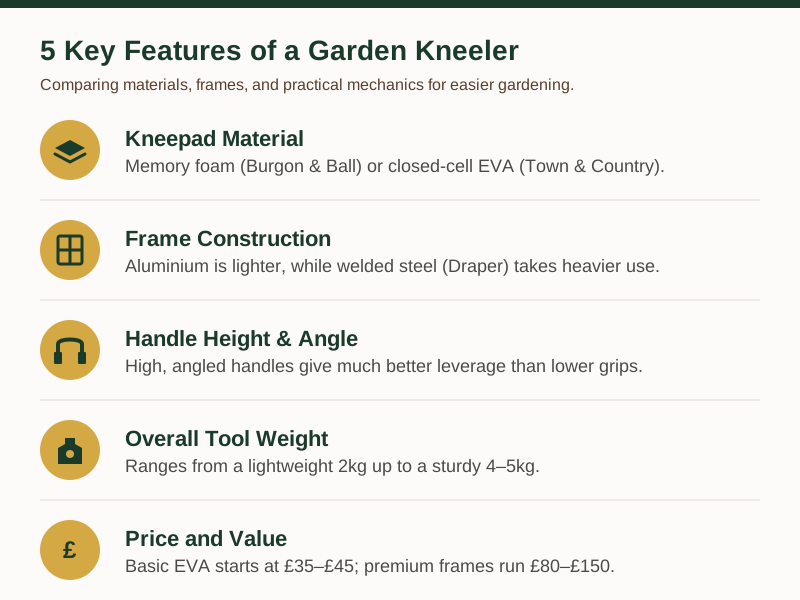
Handle height and angle – The handle should be high enough that, when you pull, your back stays close to vertical. A good rule of thumb is a handle that sits about 30 cm above the pad; anything lower forces you to hunch, re‑engaging the back muscles you’re trying to protect.
Stability on wet grass – Look for non‑slip feet or a solid metal base. Models with rubberised corners or a wide footprint grip the ground better when the soil is soggy – a point confirmed by gardeners who repeatedly report slipping on cheap plastic bases after a May downpour.
Weight and portability – You’ll need to lift the kneeler out of the shed and maybe carry it across a muddy path. Foam-only pads like the Kneelo weigh next to nothing, aluminium-framed stools stay light at roughly 2 kg, while steel-framed heavy-duty options can run 4–5 kg. If you have limited arm strength, the lighter the better, provided it still offers a sturdy base — just remember a lighter pad-only option skips the handle entirely.
Material and water resistance – Neoprene‑covered pads stay dry and resist mould, whereas plain EVA can absorb water over time. In the damp British climate, a waterproof cover is worth the extra few pounds.
Quick checklist – before you click “add to basket”, ask yourself:
- Does the handle allow a one‑handed pull‑up?
- Are the feet rubberised or metal‑clad for wet conditions?
- Is the overall weight manageable for you to lift when full of mud?
- Does the pad material stay dry after a rainstorm?
Now that you know what to look for, Download the Free Easier Gardening Tool Checklist to compare models side‑by‑side and make a confident choice.
How to Stand Up from a Garden Kneeler Safely
Even with a good kneeler, the way you move matters. Here is the mechanical way to get back on your feet without straining your lower back.
Step 1: Square your grip Place both hands firmly on the centre of the side handles. Do not grip too far forward or back, as this can tip the frame backwards or forwards in the mud.
Step 2: Tuck your toes Before you pull upwards, make sure your toes are tucked under or your feet are flat on the ground behind you, ready to take your weight as soon as your knees lift.
Step 3: Let your arms do the work Keep your back straight and pull upwards with your arms, rather than trying to uncurl your spine. Think of it as pushing the ground away with your hands.
Step 4: Step out, don’t twist Once you are upright, step away from the kneeler rather than twisting your torso to pick it up immediately. Turn your whole body to face it before lifting it by the handles to move to the next bed.
Frequently Asked Questions
Can I use a kneeler if I have a bad back?
Yes, but only if the handle lets you stand up without twisting or over‑reaching. A kneeler that forces you to use both hands unevenly or to bend sharply will still strain the lumbar spine, so look for a high, angled handle that does the lifting for you.
Are kneelers suitable for wet grass?
Only if they have non-slip feet or a solid metal base. A foam pad like the Kneelo has no rigid base to grip with at all, so on a soggy lawn it’s worth laying it on drier ground where possible; framed kneelers with rubberised feet are the better bet for consistently wet grass.
What is the best height for a kneeling stool?
Aim for a stool that brings you to roughly 45–50 cm off the ground – about 18–20 inches. That height lets most gardeners stand up without fully extending the knees, reducing the load on both joints and back. Adjust up or down a few centimetres depending on your own height.
Key Features Comparison
| Feature | Burgon & Ball Kneelo | Draper EVA Foam Kneeler | Draper Heavy Duty Seat |
|---|---|---|---|
| Material | Neoprene & Memory Foam | Closed-cell EVA | Rubberised Pad |
| Frame | None – foam pad only | Plastic | Impact-resistant Plastic |
| Handles | None (pad only) | Carry handle | Reversible seat + stand handles |
| Weight | Under 1 kg | Lightweight | A few kg |
| Weight capacity | N/A | N/A | 90 kg |
| Price (typical) | £15–£20 | £10–£20 | Under £30 |
The Stand-Up Test
Comfort and lever action turn out to be two separate problems, not one. If it’s your knees that ache, the Kneelo pad sorts that cheaply. If it’s the stand-up wince that’s putting you off gardening altogether, that’s a job for the handled Draper seat-kneeler or the Fiskars extractor, not a softer pad. Match the tool to the actual complaint and you’ll get more out of it than buying on price or brand name alone.
If the ache persists despite a better tool, a quick chat with your GP or an occupational therapist is the sensible next step – they can flag any underlying issues that a garden aid alone won’t solve. This guide is general information, not medical advice, so anything condition-specific is worth checking with a qualified professional rather than taking my word for it. If you’ve found a kneeler that works brilliantly for your own setup, get in touch and let me know.
Ready to lock in a choice that matches your garden and your body? Download the Free Easier Gardening Tool Checklist and keep the weeds at bay without the wincing. Happy, pain‑free planting!
Related Guides
For a complete overview, see our Gardening with a Bad Back: Tools to Stop Bending and Strain.
Where These Recommendations Are Grounded
- Thrive - Gardening for health charity
- Arthritis UK - Joint protection advice
As an Amazon Associate I earn from qualifying purchases. The products linked above are ones I would use or recommend in my own garden.
Buy Fiskars Xact Extractor on Amazon → (paid link)
Check Draper garden kneeler price → (paid link)
Check Burgon & Ball Kneelo price → (paid link)