Best Lightweight Cordless Hedge Trimmers for Weak Grips UK
As an Amazon Associate I earn from qualifying purchases. This page contains affiliate links — if you buy through them, I earn a small commission at no extra cost to you.
Here’s the trap: two trimmers can carry almost identical numbers on the box, and one will leave your wrist aching after ten minutes while the other won’t. Weight alone is the least useful figure on a spec sheet if you’ve got a weak grip or a stiff back — where that weight sits, and how hard the trigger fights you, matters more than the kilos ever will.
If you’d like a side‑by‑side comparison of the features that matter most, download the Free Easier Gardening Tool Checklist – it’s the quickest way to sort the specs without a headache.
Why Does Weight Distribution Matter More Than the Scales?
A hedge trimmer’s balance dictates how heavy it feels in use. If the battery sits too far forward, the machine pulls downwards, forcing your wrists and lower back to constantly fight the leverage. A properly balanced trimmer centres the weight near the trigger, sharing the load evenly across your forearm and shoulder.
📺 Watch: Hedge trimmers - Buyer's Guide — BBC Gardeners’ World Magazine
A trimmer that tips the scales at 2 kg can feel heavier than a 2.5 kg unit if the mass sits at the wrong end. Most cordless hedge trimmers tuck the battery in the handle, pulling the centre of gravity forward. That front‑heavy feel means your arm has to support the whole weight while your shoulder and back compensate for the forward pull. As the charity Arthritis UK rightly points out when discussing joint protection, reducing the leverage and grip force required for a task is key to avoiding flare-ups.
Picture a balanced tool: the battery sits just behind the trigger, the motor is centred, and the handle arches gently towards your palm. Your arm acts like a lever, and the load is shared rather than being a single, stubborn tug. The result? Less fatigue after a 20‑minute session and a noticeable reduction in the ache that usually builds up in the lower back.
Anti‑vibration systems are the other half of the equation. A well‑damped motor keeps the hum from travelling up the handle, sparing arthritic joints from the constant shake. The honest answer is, a trimmer that feels “light” on the scale but shudders in your hand is actually doing the opposite of what you need.
If you’re keen to explore more about tools that protect the back, have a look at our general advice on the blog.
Top 5 Recommendations
Best Overall – Bosch AHS 50‑20 LI
At roughly £180–£210 the Bosch AHS 50‑20 LI weighs about 2.5 kg and slots the 18 V battery just behind the trigger. The “easy‑squeeze” trigger clicks in three light strokes instead of one hard pull, which makes a genuine difference for arthritic fingers. The anti‑block system stops the blade from seizing on a thick branch, so you don’t have to muscle through a jam.
On a typical 1m-high privet hedge, the vibration stays low enough that it shouldn’t leave hands tingling the way a heavier, bottom-heavy model can after half an hour’s trimming. The only downside is the price, but the reduced strain makes it worth the extra few quid.
Best Budget – Einhell GE‑CH 1846 Li
If you’re watching the wallet, the Einhell at around £120–£140 offers an 18 V battery and a 460 mm blade. It’s a solid, lightweight option (about 2.2 kg) and the trigger is reasonably soft, though not as refined as the Bosch. The trade‑off is a noticeably louder motor than the others here, which can grate on a quiet suburban street.
For occasional trimming of low hedges, it does the job without breaking the bank. Just be aware that the plastic housing feels a touch less robust after a few months of regular use.
Best for Arthritic Hands – Stihl HSA 40
Stihl’s HSA 40 (available in the UK for roughly £190–£220 with batteries, or around £139 as a tool-only unit if you already own an AS battery) runs on Stihl’s 12 V AS system and weighs a beautifully balanced 2.1 kg. What makes it friendlier for stiff or arthritic hands is the combination of genuine balance — the weight sits squarely between your two hands rather than pulling forward at the blade — and a two-handed grip design that lets you share the load across both hands rather than doing all the work with your trigger fingers. The vibration dampening is spot on, too. It’s not cheap, but for keeping you gardening without aching joints the next morning, it’s worth its salt.
Best for Reach Without the Weight – Husqvarna 115iHD45
At around £150 without the battery, this Husqvarna model weighs 3.2 kg on its own — closer to 4 kg once the battery’s clipped on — but it carries the extra mass exceptionally well. The keypad starting system means there is no heavy safety switch to muscle down before you begin. The motor is quiet, and the weight sits squarely between your hands. It’s slightly heavier than the Stihl, so if your grip gives out very quickly, stick to the lighter models. But for a solid, low-vibration cut that does the work for you, it does what it says on the tin.
Best for Skipping the Ladder – Gtech HT50 (paid link)
Buy Gtech HT50 on Amazon → (paid link)
The Gtech HT50 isn’t a compact handheld like the other four here — it’s a telescopic pole trimmer with around 3m (10ft) of reach and a 135° adjustable head, priced anywhere from £160 to £250 depending on the retailer. At 2.94 kg it’s actually the heaviest tool on this list, so it won’t suit you if your grip fatigues fast. But that weight buys you something the others can’t: trimming the top of a tall hedge from flat ground, with no ladder and no stretching overhead. If it’s your back or shoulder doing the complaining rather than your hands, that trade is usually worth it. Work it in short bursts and let the pole rest against the hedge between cuts, rather than holding the full length out on your arms.
How to Trim Hedges Without Straining Your Grip
Keep the work close to your body The further you extend your arms, the heavier the trimmer becomes. Keep your elbows tucked in to let your core and shoulders take the weight rather than your wrists. This keeps your centre of gravity stable and stops your lower back from overworking.
Work in short, horizontal sweeps Don’t try to muscle the blade through thick growth in one go. Let the motor do the work for you with steady, sweeping motions. Forcing the blade through a tough branch just sends all the vibration straight back into your hands.
Break the job down If your grip tires quickly, stop after ten minutes. It is far better to do the front of the hedge on Tuesday and the top on Thursday than to lose your grip entirely halfway through a session. Gardening is not a race, and pacing yourself keeps you out there longer overall.
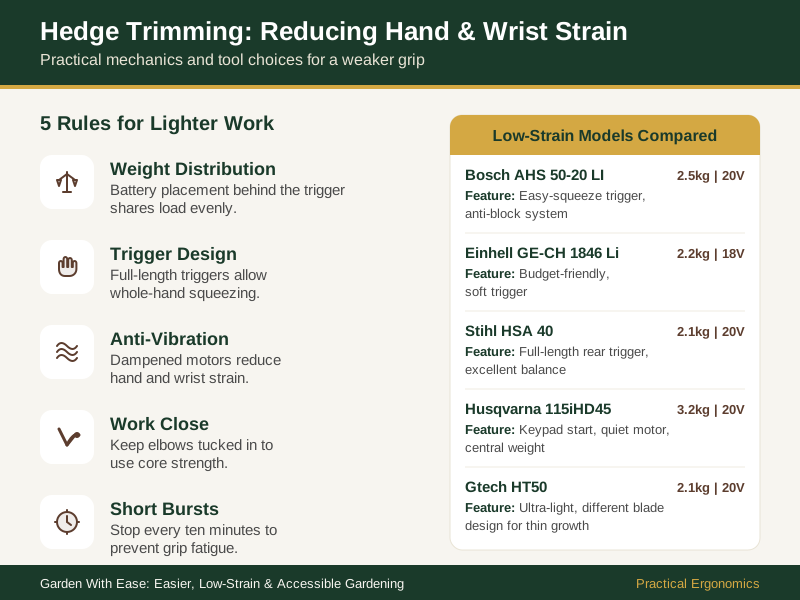
Hedge Trimmer Weight & Balance Guide
| Model | Weight (kg) | Battery Voltage | Key Feature for Weak Grip |
|---|---|---|---|
| Bosch AHS 50-20 LI | 2.5 | 18V | Easy-squeeze trigger, anti-block system |
| Einhell GE-CH 1846 Li | 2.2 | 18V | Budget-friendly, soft trigger |
| Stihl HSA 40 | 2.1 | 12V (AS system) | Two-handed grip, excellent balance |
| Husqvarna 115iHD45 | 3.2 | 36V | Keypad start, quiet motor, central weight |
| Gtech HT50 | 2.94 | 18V | Telescopic 10ft reach, no ladder needed |
📺 Watch: The Best Battery Hedge Trimmers Tested! Which Should you BUY? — Machinery Nation
Common Questions
Are cordless hedge trimmers lighter than electric ones?
Generally, yes, when you factor in the drag of a heavy trailing cable. While the battery adds a little weight to the tool itself, you aren’t constantly fighting the pull of a long wire catching on the paving, which makes the whole job much lighter work.
What is the best handle design for a weak grip?
Look for a loop or wrap-around front handle and a full-length trigger on the rear. This allows you to adjust your grip angle as you work and divides the squeezing force across your whole hand rather than just one or two fingers.
Can I use a telescopic trimmer if I have a bad back?
The honest answer is, it depends on your shoulder strength. Telescopic handles add reach so you avoid bending or climbing, but the further the cutting head is from your body, the heavier it feels due to leverage. As the gardening for health charity Thrive often suggests, keeping tools close to your body is crucial for protecting your joints, so only use long-reach tools if you can comfortably manage the shift in balance.
Getting the right tool isn’t about giving in; it’s about gardening smarter so you can keep doing it. If your grip only tires late in a session, balance and trigger design matter more than the number on the box, so the Bosch or the Stihl will serve you well. If your hands give out early or arthritis is the bigger factor, put raw weight and a full-hand trigger first, even if that means a smaller hedge takes two sittings instead of one. And if it’s your back or shoulder doing the complaining rather than your hands, the pole trimmer earns its extra weight by keeping you off a ladder entirely. If you’re still not sure where to start, feel free to contact me or read a bit more about this site’s approach. Take your time, let the trimmer do the hard work, and you’ll be sorted.
Related Guides
For a complete overview, see our Gardening with Arthritis: UK Tools and Tips That Actually Help.
What the Spec Sheet Doesn’t Tell You
A kilogram figure on a box says almost nothing about how a trimmer will feel in a stiff or arthritic hand by the end of a session — that comes down to where the weight sits and how hard the trigger bites, not the number printed on the packaging. Manufacturers revise models and battery specs more often than you’d expect, so it’s worth double-checking the current listing before you buy, especially on voltage and weight, which can shift between versions carrying the same name.
For further reading on joint-friendly gardening, Arthritis UK’s joint protection guidance, Thrive’s gardening-for-health resources, and the RHS’s advice on tool safety and maintenance are all worth a look.
As an Amazon Associate I earn from qualifying purchases. The products linked above are ones I would use or recommend in my own garden.