Best Lightweight Lawn Mowers for Bad Backs & Arthritis UK
Push a heavy mower up and down the lawn a few times and the maths becomes obvious: it’s not one big lift that does the damage, it’s forty small ones, once per stripe, every week of the season. A 12kg corded mower dragged up the driveway and back is a slow, cumulative way to end up with a back that won’t settle for days. Switching to something genuinely light changes that arithmetic entirely. The machine needs to let you lift, start, and store it without wrestling a pull-cord or hauling a battery pack you can barely get a grip on.
Which Are the Best Lightweight Mowers for Reducing Strain?
There’s really only one mower on the UK market that gets close to the “under 5kg, fully loaded” bracket: the Gtech SLM50, at 3.5kg complete with its battery. Everything else marketed as “lightweight” is more accurately “lighter than a corded mower” — most sit somewhere between 7kg and 11kg once a battery’s clipped in, a real improvement on a petrol or corded machine but nowhere near single-hand-lift territory. That gap matters when you’re comparing spec sheets: don’t assume two mowers both described as “compact” or “cordless” will feel the same in your hands. Check the fitted weight, not the chassis weight printed on the box, because the battery is what you’re actually carrying every time you lift it.
Below are the cordless models worth comparing if low weight and an easy start matter more to you than raw cutting speed. Weights below include the battery unless stated otherwise, because that’s the figure you’ll actually feel.
- Gtech SLM50 – 3.5kg complete with its 18V battery. This is the standout pick if grip strength or a bad back rules out heavy lifting: a compact, single-handed mulching mower with a push-button start and a 25cm cutting width, better suited to a smaller lawn or borders than a big back garden. Runtime is around 30 minutes from a roughly 4-hour charge. Retailers currently list it from around £90 for the body alone up to roughly £130–£180 with the battery and charger included, so it’s worth shopping around.
- Ryobi 18V ONE+ OLM1833B – 7.5kg for the body alone, before a battery goes in, with a wider 33cm cutting width and five cutting-height settings. The appeal isn’t the weight, it’s the ecosystem: if you already own Ryobi ONE+ drills, a strimmer or a hedge trimmer, this mower shares the same 18V batteries, so you’re not buying and charging a second pack. Body-only price is around £160, plus a compatible battery and charger if you don’t already have one.
- Flymo 18V SimpliMow 320 (Kit 4.0) – around 10kg with its 4.0Ah battery fitted, cutting a 32cm width and running for roughly 26 minutes per charge, enough for up to around 200m² of lawn. It’s a familiar high-street name and a reasonable step up if the Gtech’s narrower cut feels too slow for your garden, but be honest with yourself about whether the extra weight over the Gtech is something your back can manage comfortably.
- A word on battery weight – Don’t take a spec sheet’s “chassis weight” at face value. As a rule of thumb, 18V battery packs tend to be noticeably lighter than 36V/40V packs of similar capacity, but the exact figure varies by brand and Ah rating — weigh, or ask the retailer to confirm, the complete battery-fitted unit before you buy rather than assuming.
Key Features to Look For (Beyond the Specs)
When you’re scanning a product sheet, focus on the mechanics that actually dictate how hard the tool is to use, not just the headline numbers.
📺 Watch: Cordless lawn mowers - Buyer's Guide — BBC Gardeners’ World Magazine
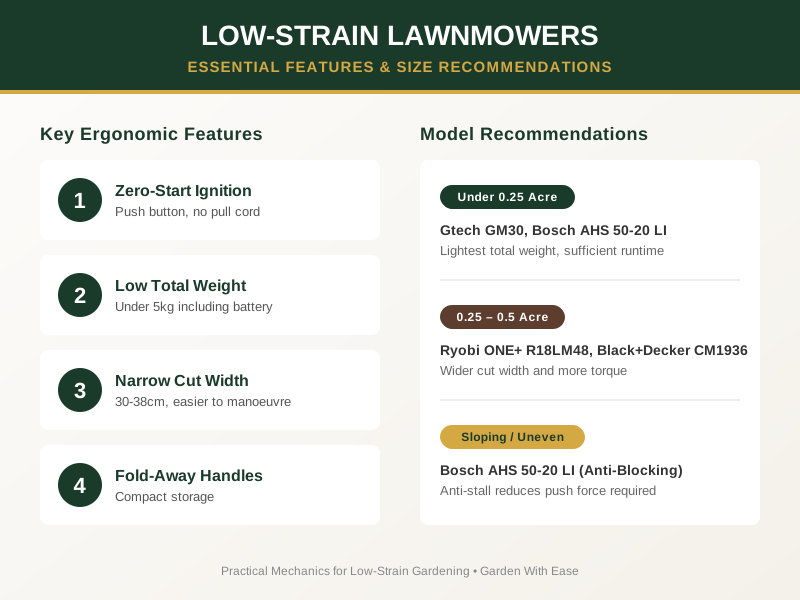
- Zero‑Start or Push‑Button ignition – Removes the need for a recoil starter, which is a nightmare for stiff or arthritic hands. Look for a button that clicks with a light press rather than a hard push. If you need condition-specific advice on managing hand pain, charities like Arthritis UK are brilliant, but mechanically speaking, you want a trigger that does the work for you.
- Cut width vs. weight balance – A wider cut (50 cm +) shaves mowing time, but every extra centimetre usually adds a kilogram or two. For a 0.25‑acre lawn, a 30‑38 cm width is the sweet spot.
- Battery weight matters – A mower that feels light on its own can become a hassle once the battery is attached. A 3 kg chassis with a 1 kg battery is harder to handle than a 4 kg unit with a 0.5 kg pack.
- Fold‑away handles or compact storage – Handles that swivel or fold let you tuck the mower into a small shed or the boot of a hatchback without a lift‑assist.
- Wheel size and tread – Larger, rubber‑treaded wheels roll over uneven lawns with less effort, reducing the push force needed on slopes.
Pro Tip: Always add the battery weight to the chassis weight before you decide. If the spec sheet lists “2.5 kg” and the battery is “1.2 kg”, the real lifting weight is 3.7 kg – the figure you’ll actually feel when you pick it up.
How to Choose the Right Mower for Your Lawn Size
Matching mower power to lawn area prevents wasted money and unnecessary physical strain. Here’s a quick guide:
| Lawn Size | Recommended Model(s) | Reason |
|---|---|---|
| Under 0.25 acre (typical suburban front garden) | Gtech SLM50 | Lightest complete weight by a clear margin, best suited to a smaller lawn given its narrower 25cm cut |
| 0.25–0.5 acre (medium back garden) | Ryobi 18V ONE+ OLM1833B, Flymo 18V SimpliMow 320 | Wider cut width for fewer passes, at the cost of several extra kilos to lift |
| Sloping or uneven terrain | Ryobi 18V ONE+ OLM1833B (larger wheels) | Bigger, chunkier wheels roll over uneven ground with less push force than a small mower’s wheels |
If your garden is a mix of flat lawn and gentle slope, a mower with larger wheels and a wider wheelbase needs less forward push than a small, light one — that’s a genuine trade-off against the Gtech’s low weight, not a flaw in either machine. Match the mower to the ground, not just to the number on the box.
How Do You Maintain and Store a Mower Without Bending?
To maintain and store a mower without straining your back or knees, you need to keep the machine at waist height and avoid any tasks that require bending, scrubbing, or heavy lifting. Keeping the mower in good shape shouldn’t become another source of strain.
- Cleaning: A soft‑bristled brush or a garden hose with a gentle spray does the job. Avoid scrubbing with a stiff wire brush while crouched on the patio.
- Blade sharpening: Trying to sharpen a blade on a low workbench is a fast track to a sore back, since it forces the same hunched posture as any other ground-level task. Either send the blade to a local garden centre for a professional grind, or use a long‑handled sharpening tool that lets you work standing upright.
- One‑handed cleaning: Detach the battery, lay the mower on its side on a raised surface, and pull the grass‑catch tray out with a single hand – no need to twist or reach.
- Storage: Mount the mower on a heavy-duty wall hook at waist height or keep it on a low shelf with the handle folded. This avoids lifting it into a high shed and keeps the battery accessible for charging.
How to Mow the Lawn Without Straining Your Back
Even with the lightest mower on the market, how you push it dictates how your back feels the next morning. Gardening health charities like Thrive rightly emphasise the importance of posture, and a few mechanical adjustments make a world of difference.
1. Set the handle to waist height Your elbows should be slightly bent, and you should be able to walk completely upright. If you are stooping forward to reach the handle, your lower back is taking the entire load of the push.
2. Push with your legs, not your arms Keep the mower reasonably close to your body. Walk smoothly forward, letting the momentum of your legs move the machine. If you lock your arms out straight and push from your shoulders, your upper back will tire out in minutes.
3. Turn with your feet, don’t twist your waist When you reach the end of a run, don’t plant your feet and twist your spine to haul the mower around. Push down slightly on the handle to lift the front wheels, and walk your feet in a small circle to turn the machine.
4. Break the lawn into sections There is no rule saying the whole lawn has to be cut in one go. If your grip or back gives out somewhere in the second hour of a session, cut the front lawn on a Tuesday and the back lawn on a Thursday.
Frequently Asked Questions
Can I use a standard extension lead with a cordless mower?
No, you cannot plug an extension lead into a cordless mower. They run entirely on their removable battery packs. If you find the mower dying before you finish the lawn, you’ll need to buy a spare battery from the same brand to swap in halfway through.
Are 18V or 40V batteries better for limited mobility?
The honest answer is that 18V batteries are generally much better if you have limited mobility because they are lighter and easier to carry. A 40V pack gives a bit more power for very thick turf, but that extra weight on the chassis usually outweighs the benefit for a standard suburban lawn.
How long does the battery last on a full charge?
You can typically expect roughly 30 to 60 minutes of runtime from a lightweight cordless mower. This is usually plenty to cut a small to medium lawn in one session, but if you have a larger area, a quick‑swap secondary battery will get the job sorted.
Do I need to buy a separate battery for the mower?
Yes, you often have to buy the battery separately. Many retailers sell the mower as a “bare unit” to keep the headline price down. Always check the product listing – if it says “kit” you’ll get the battery and charger; if it says “bare unit”, you’ll need to purchase a compatible pack yourself.
Weigh Up What You Actually Carry
Choosing a mower that respects your back and grip is the first step to keeping your garden looking tidy without the aches. The Gtech SLM50 is the one genuinely sub-5kg option on the UK market; step up to a wider cut and you’re trading that low weight for speed, so weigh up which one your body can actually cope with each week. Pair the right mower with a sensible battery ecosystem and you’ll find mowing becomes a quicker, less painful routine rather than a dreaded chore.
If you want to know a bit more about why this site takes mowers this seriously, you can read more about it here. Otherwise, if you’ve just identified the gaps in your current kit, the next logical move is to Download the Free Easier Gardening Tool Checklist – it helps you spot other tools that might be adding unnecessary strain.
Got a question that isn’t covered here, or want to share a piece of kit that worked for you? Drop me a line via the contact page, and we’ll sort it out together. You can also find more practical reviews on ergonomic kit over on the blog. Happy, low‑strain mowing!
Related Guides
For a complete overview, see our Tools for Gardening with Limited Mobility: Low-Effort UK Guide.
The Weight You’ll Actually Feel
Prices, stock and exact specs on any of these move fast, so check the retailer’s current listing before you buy rather than relying on the numbers above. And if a health condition — not just general aches — is shaping how you garden, a word with your GP or one of the charities below is worth more than any spec sheet.
- Arthritis UK – Managing Joint Pain
- Thrive – Advice for Gardening with Limited Mobility