Best Hand Pruners for Arthritic Hands (UK Guide)
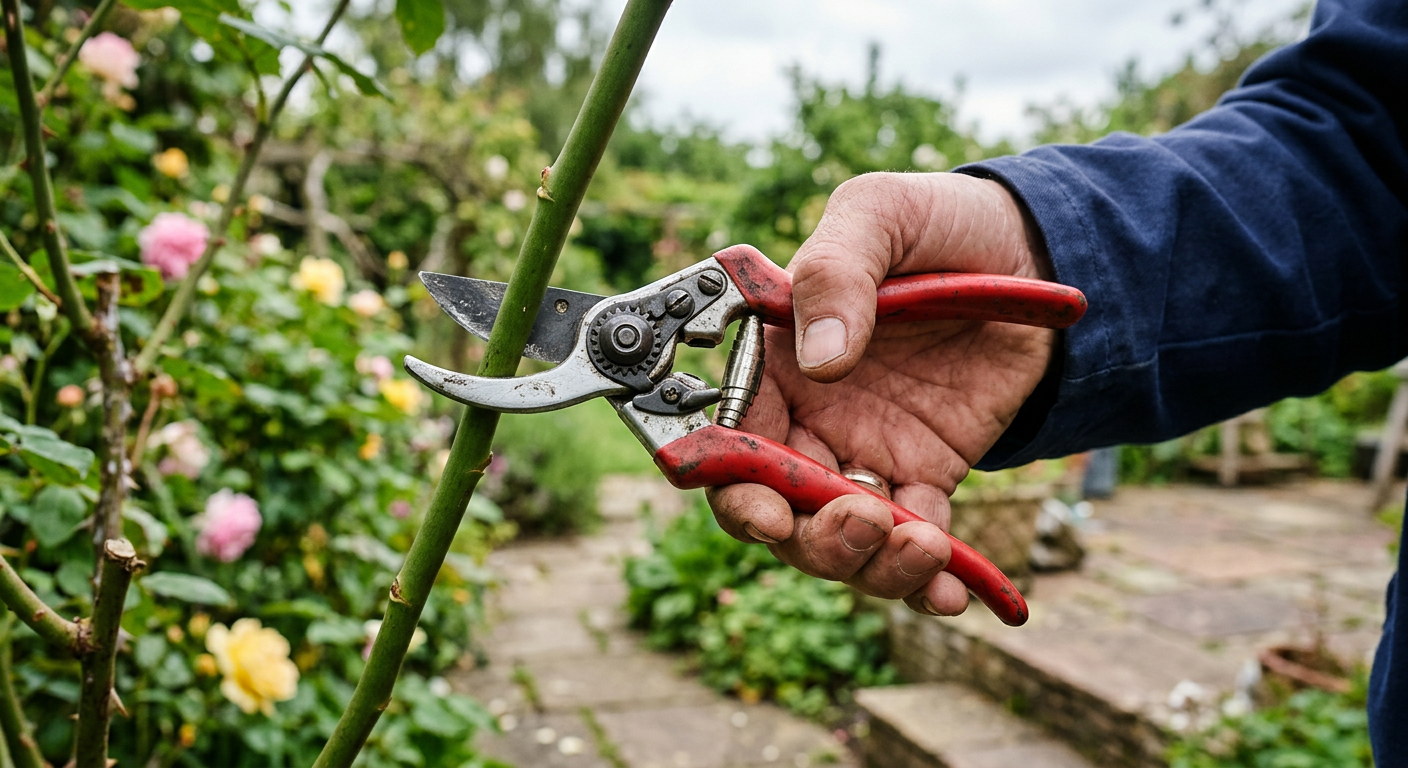
Try this before you buy anything: make a fist, hold it for a few seconds, then let go slowly. Notice where the ache settles — across the knuckles, or down through the wrist? That’s the split this whole guide turns on. A fixed-handle secateur with an anvil blade punishes the knuckles with one hard squeeze; a bypass blade on a ratchet or rotating handle spreads the same cut across several light ones and keeps the wrist roughly straight while it does it. Get that mechanism right and pruning stops being the thing that ends your gardening afternoon early.
Why Do Standard Secateurs Hurt Arthritic Hands?
Standard secateurs force you to rely entirely on your own grip strength and wrist stability, which is exactly what arthritis compromises. Most garden-centre models use a fixed-handle design and an anvil blade. An anvil blade crushes the stem against a flat surface, demanding a firm, sustained squeeze. For arthritic hands, that extra pressure translates straight into joint pain.
📺 Watch: Bypass Secateurs, Anvil Pruners and Ratcheted Pruners: A Guide By Garden Writer Martin Fish — Darlac Ltd
Bypass pruners, on the other hand, slice like scissors. They require less force and leave a cleaner wound, which matters more than it sounds when your wrist stability is already compromised.
Also, standard models use a fixed lever arm set at a single angle, so you are forced to twist your wrist to line up the cut. That torque adds up, especially on thicker stems. A ratchet mechanism changes the game by dividing a single hard squeeze into three or four light squeezes. Meanwhile, a rotating handle lets the blade stay aligned with the stem as you open the jaws, keeping the wrist in a neutral position.
I am not a doctor, and if you are dealing with severe joint pain, the occupational therapists at Arthritis UK offer excellent practical guidance. But mechanically speaking, arthritis isn’t just about losing grip strength; it’s about losing the steady wrist angle that lets you apply force efficiently. A tool that respects that geometry does the heavy lifting for you. (Have a look through the blog for more of my thoughts on joint-friendly garden design.)
The Gold Standard: Felco F7 and F15
For sheer longevity and precision, the Swiss‑engineered Felco range is hard to beat.
Felco F7 is the heavyweight champion for larger hands. It has a 25 mm cutting capacity and blades that stay sharp for years, and the revolving handle cuts the effort needed to close the jaws by around 30%, per Felco’s own figures. The mechanism clicks into place with each squeeze, meaning you’re not fighting a stiff spring each time. The downside? At roughly £70–£90 it’s a serious outlay, and Felco rates it for hands on the larger side. Smaller wrists may find it a tad bulky.
Felco F15 is the one to look at if the F7 feels too big. It’s Felco’s compact rotating‑handle model, built for smaller hands rather than as a stripped‑down F7 — same swivelling action, scaled to a narrower grip. Pricing sits close to the F7. Even on a dense hawthorn hedge, the rotating handle keeps the wrist from twisting beyond a comfortable angle, and a clean bypass cut is enough to avoid sap ooze.
For left‑handed gardeners, it’s Felco F10 you want, not F15 — F15 is a right‑handed tool. The F10 carries the same rotating handle as the F7 and mirrors the blade orientation for a left hand, but it’s built to the F7’s larger‑hand size, not the F15’s smaller grip. If the swivel action isn’t essential, Felco also makes the F9: a left‑handed large‑hand model without the rotating handle, usually a little cheaper.
Felco backs its whole range with a lifetime guarantee. In practice, that means the steel stays razor‑sharp far longer than a typical cheap blade, so you’re not repeatedly cranking the secateurs to compensate for dullness – a common source of hand fatigue.
Budget note: The Darlac Expert Bypass Pruner with rotating handle is worth a look at the budget end. The rotating handle is the same principle as the pricier swivel pruners – it lets the tool turn in your grip rather than forcing your wrist to twist – paired with a razor-sharp SK5 high-carbon-steel blade.
The Power Assist: Fiskars X-Series PowerGear
If the Felco price tag feels steep, the Fiskars X-Series PowerGear bypass pruner (model P961) offers a solid mid‑range alternative. Its PowerGear mechanism multiplies cutting power by roughly three times compared with a standard pair, achieved through a cam‑action gear inside the handle. The result is three light squeezes instead of one hard one – exactly the kind of mechanical assist that tired hands appreciate.
📺 Watch: Fiskars Powergear X Upx86 Test — Wooly’s World
The rolling handle sits comfortably in the palm, and the low‑friction coated stainless‑steel blades resist rust – a real plus for the damp British climate. On rose canes up to 12 mm thick, the geared assist keeps the effort closer to using a garden fork in soft soil than wrestling with a pair of pliers.
Retailers such as B&Q, John Lewis, and Amazon UK stock it, typically for around £25–£40. Durability holds up well under regular garden use, though the gear can feel a touch noisy after a few months of heavy pruning.
Budget Power Picks: Spear & Jackson
For gardeners watching the pennies, Spear & Jackson have a couple of ratchet‑enabled options that do the job, albeit with some caveats.
- Spear & Jackson Razorsharp Geared Anvil – The ratchet gives you a mechanical assist, but the anvil blade design means you still need a firm grip to avoid crushing live wood. Users report the blades dulling after a season of mixed‑hardwood pruning, and warranty claims can be a bit of a faff. If you mainly prune dead wood, it’s worth a look; otherwise, stick to bypass.
- Spear & Jackson Ratchet Secateurs – These feature a rotating handle and a modest ratchet. They sit at roughly £30–£35 and are widely available at local garden centres. The trade‑off is a slightly heavier aluminium body, and the grip plastics can become slick when wet.
- Wilkinson Sword Ratchet Anvil Pruner – The ultra‑budget pick. It’s a straightforward 3-step ratchet anvil design with a 22mm cutting capacity, and does the basic job of dividing a hard squeeze into lighter stages without the price of the Fiskars or Spear & Jackson options above.
How to Test Ratchet Secateurs Before Buying
The key with any budget model is to test the ratchet action before you part with your cash. If you are in the garden centre, run through these quick checks:
- Check the resting grip width: Before you even squeeze, see how wide the handles sit when fully open. If you have to stretch your fingers uncomfortably just to grasp them, they are too big for your hand.
- Test the unloaded ratchet: Squeeze the handles together without cutting anything. You should feel distinct, smooth clicks. If the mechanism sticks or feels jerky when empty, it will be a nightmare under load.
- Assess the weight balance: Hold the secateurs loosely in your palm. If the heavy steel blades make the tool tip forward, your wrist will have to fight that imbalance all afternoon.
How to Choose the Right Size
Ergonomic design doesn’t mean a one‑size‑fits‑all. The handle diameter, overall length, and blade size all influence how comfortable a pruner feels in your hand.
- Hand size – Felco measures hand length, not palm width: base of the palm to the tip of your middle finger. Roughly 17.5cm (6⅞in) or under is Felco’s “small” bracket, covered by the F15; above that is “large” — the F7 and F10. If you’re borderline, err smaller for control unless you specifically need the extra leverage.
- Grip width – Ratchet mechanisms add bulk to the handle. If you have a narrow grip, look for a model where the handle tapers toward the joint.
- Blade length – Longer blades reach deeper into dense foliage without forcing you to stretch. However, they add weight at the tip, which can torque the wrist if the handle isn’t well‑balanced.
If you’re buying for a parent or neighbour, a quick hand‑measure (palm base to middle fingertip, the same method Felco uses) can guide you to the right model. Many retailers also list “small”, “medium”, and “large” grips – use those as a sanity check. (If you want to know why fit matters this much, there’s more on the About page.)
For a gift, the Fiskars X-Series’ SoftGrip handle detail is worth factoring in — it stays comfortable even if the recipient’s hands get a bit sweaty during a warm summer prune.
Maintenance for Arthritic Hands
Tools that demand a lot of cleaning or frequent sharpening become a nightmare when your fingers ache. Look for sap grooves – a small channel on the blade that prevents resin from sticking, as seen on the Felco models. Fiskars uses a low‑friction coating on its blades that resists rust and makes wiping clean a quick swipe.
The Royal Horticultural Society rightly points out that clean blades prevent disease from spreading between plants, but from a purely mechanical standpoint, a clean blade also requires far less force to push through a stem.
A light coat of tool oil on the moving parts every few weeks keeps the ratchet or gear smooth, meaning you won’t have to fight a stiff mechanism later on. If you find yourself wrestling with a sticky handle, it’s a sign the internals need a bit of lubrication – a simple fix that saves you a lot of hand strain.
Frequently Asked Questions
Are ratchet secateurs better for arthritis?
Yes. A ratchet splits the cutting force into several light squeezes, so you never have to apply a full, hard grip. That reduction in peak force makes the motion far kinder on sore joints and weak wrists.
Can I use Felco secateurs with one hand?
Yes, the Felco F7, F15, and left‑handed F10 are all designed for one‑hand operation. You open the blades with a quick flick of the wrist, then the rotating handle does the heavy lifting. It still needs a modest wrist rotation, but it’s far less taxing than a fixed‑handle pair.
What is the difference between bypass and anvil?
Bypass secateurs cut like a pair of scissors – the two blades pass each other, giving a clean slice that requires less force and is easier on live stems. Anvil secateurs crush the stem against a flat surface, which can be much harder on weak hands and leaves a ragged cut better suited to dead wood.
Where can I buy these in the UK?
You’ll find Felco and Fiskars models at John Lewis, B&Q, Dobbies, and online at Amazon UK. Local garden centres often stock Spear & Jackson and Silverline lines. Checking the retailer’s website for stock updates saves a wasted trip to the shop.
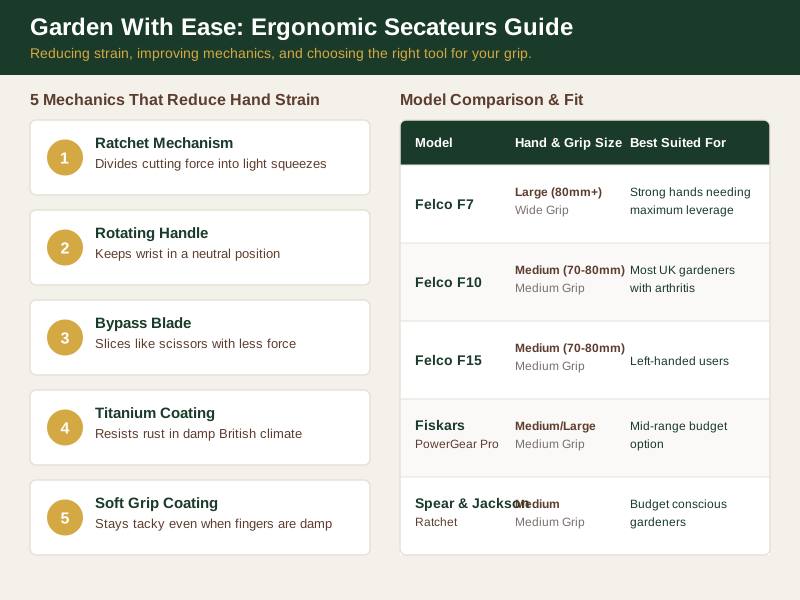
Hand Size & Grip Width Guide
| Model | Target Hand Size | Grip Width | Best For |
|---|---|---|---|
| Felco F7 | Large (17.5cm+ hand length) | Wide | Right‑handed, strong hands needing maximum leverage |
| Felco F15 | Small (under 17.5cm) | Narrow | Right‑handed, smaller or arthritic hands |
| Felco F10 | Large (17.5cm+ hand length) | Wide | Left‑handed gardeners |
| Fiskars X-Series PowerGear | Medium/Large | Medium | Mid‑range budget option |
| Spear & Jackson Ratchet | Medium | Medium | Budget conscious gardeners |
📺 Watch: Secateurs - Buyer's Guide — BBC Gardeners’ World Magazine
The Only Measurement That Matters
Here’s the thing the brand names and spec sheets tend to bury: a bypass blade on a ratchet or rotating handle does the heavy lifting for anyone, but which specific model gets you there is gated almost entirely by hand length and which hand you cut with – not budget, not brand loyalty. Right‑handed and larger‑handed, it’s the Felco F7. Right‑handed and smaller‑handed, the F15. Left‑handed, the F10 (or the F9, if you don’t need the swivel). The Fiskars X‑Series pruner is the honest mid‑range answer if the Felco price tag doesn’t work. If the budget is tight, a well‑chosen Spear & Jackson model can still do the job – just keep an eye on blade wear.
Prices and exact specs move around between retailers, so treat the figures above as a starting point and check the manufacturer’s current listing before you buy – and if joint pain is severe rather than everyday stiffness, a qualified professional’s opinion matters more than anything in this guide. Investing in the right pair isn’t a luxury; it’s an investment in keeping your garden thriving and your hands pain‑free. If your current pair feels gritty or dull, it might be time for a fresh set. Drop me a message via the contact page to request my Free Easier Gardening Tool Checklist – it walks you through the key specs, price ranges, and where to buy, so you can make a confident choice without the guesswork.
Happy pruning, and remember: the garden will still be there when you’re ready, but a comfortable tool makes the waiting a lot more pleasant.
Related Guides
For a complete overview, see our Gardening with Arthritis: UK Tools and Tips That Actually Help.
Where the Facts Came From
The mechanical figures in this guide are checked against Felco’s and Fiskars’ own published specifications rather than marketing copy. For the health side, Arthritis UK publishes practical guidance on joint pain and everyday tasks like gardening, and the Royal Horticultural Society covers garden hygiene and tool maintenance.