How to Garden Without Bending: Long-Handled Tools for Bad Backs
As an Amazon Associate I earn from qualifying purchases. This page contains affiliate links — if you buy through them, I earn a small commission at no extra cost to you.
Try this before you buy anything: stand up, hold an imaginary trowel out in front of you, and lower it to ankle height without bending your knees. Feel where the strain lands? That’s the muscle group that ends up doing the work every time you kneel over a border with a short-handled tool. Now do the same motion holding your arms straight down at your sides – the strain moves almost entirely out of the lower back. That difference, multiplied over an hour of weeding, is the whole case for long-handled tools.
The Physics of Why Bending Hurts and Standing Doesn’t
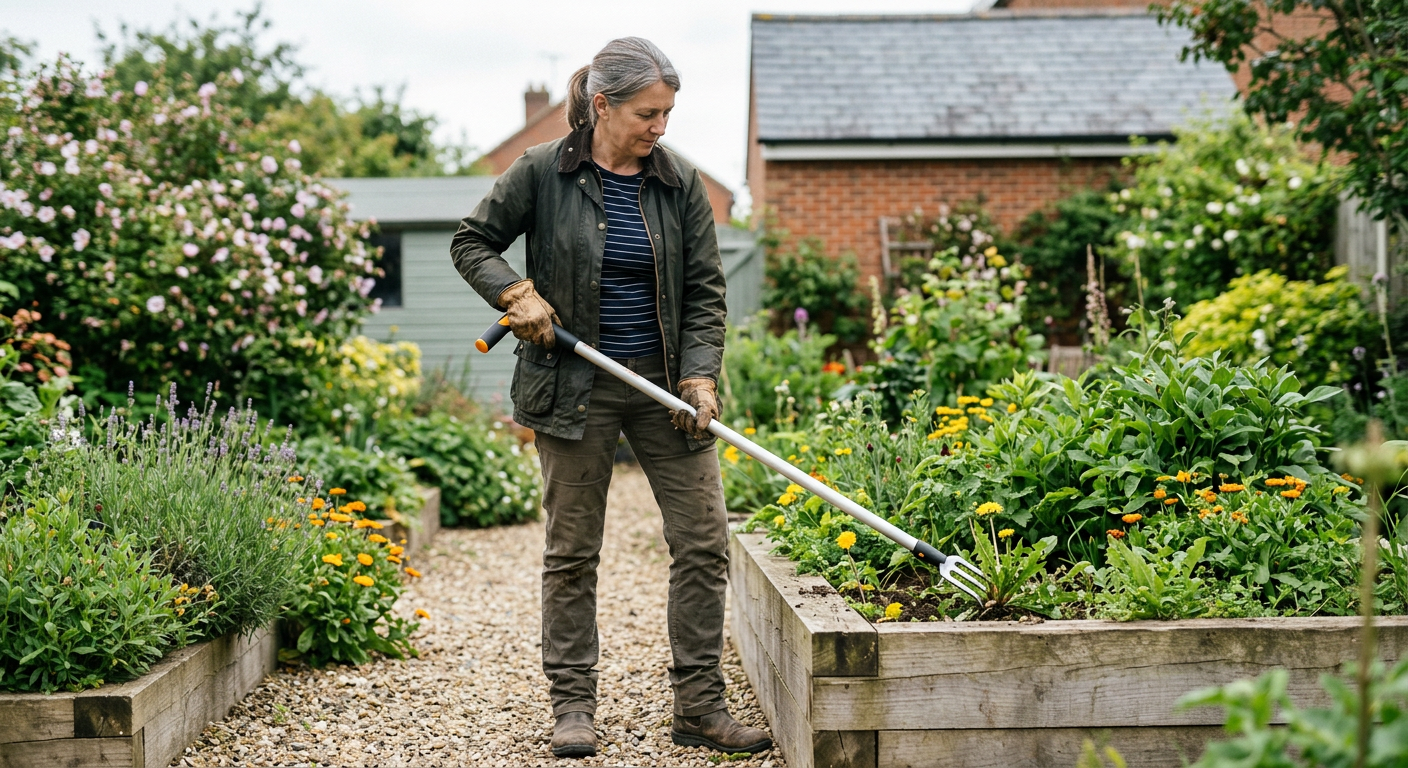
A longer handle acts as a lever that does the heavy lifting for your spine. By extending the distance between your hands and the soil, you eliminate the need to bend at the waist, keeping your back in a neutral, upright position. This transfers the physical effort away from your vulnerable lower back and lets your legs and the tool’s own mechanics do the work.
That is the core of “stand and reach” versus “bend and lift”. When you bend, the lever arm between your hips and the load shortens, so your back has to produce more force to compensate. Extend the handle, and the load is transferred to the longer arm. The gardening charity Thrive regularly highlights this sort of upright gardening as one of the most effective ways to keep working comfortably as our bodies change.
Length helps, but only up to a point – too long and you lose control and start over-reaching, which cancels the benefit out. A handle around 1.2–1.5 metres is usually the sweet spot for most garden beds.
Weeding a deep bed with a standard short-handled trowel forces a hard forward bend at the waist within minutes — you end up fighting physics rather than using it. A long-handled weed puller changes the geometry entirely, letting you stay upright and finish the job without a single wince.
What Actually Matters More Than the Price Tag
Before we get into specific tools, it’s worth being upfront about the one thing that decides whether any of this works: the mechanism, not the brand or the handle length. A long handle only helps if the head does its share of the work too – a grip that traps the root, a rolling action that spreads the force, a hinge that lets the tool’s own weight do the swinging. Two tools can share an identical handle length and feel completely different in use, because one asks your hand and wrist to supply all the force and the other doesn’t. Keep that in mind as you read the comparisons below – price is a rough guide to build quality, but it isn’t the deciding factor.
Long-Handled Weeding & Removal Tools
A good weed puller does more than just add length – it needs a comfortable grip and a mechanism that extracts the root without a brutal yank. If you regularly read the blog, you will know I am a stickler for tools that do the actual pulling for you.
📺 Watch: 🌱 TOP 5 Best Long Handled Weed Pullers 2025 – Effortless Weeding Made Simple — Review Source
Fiskars Xact weed puller (paid link) – Typically somewhere in the £35–£55 range depending on retailer. The Xact range uses a claw-and-lever design rather than a spring: four stainless steel prongs bite into the soil around the root and a sliding ejector pushes the whole thing out, so there’s no spring to seize up or go slack over time. It’s a stand-and-pull motion rather than a long telescopic reach, so don’t expect a 1.2m extension – it’s built for working close to a bed’s edge, not spanning a wide border.
Walensee Long-Handled Weed Puller – Usually closer to £25–£40 than the premium end. Roughly a 1m handle, three or five claws depending on the version, and a foot pedal that drives the claws in – simpler than the Fiskars mechanism and a firmer push is needed, but for occasional weeding it does the job without breaking the bank.
Both tools let you work from a standing position, keeping the lower back in a neutral zone. The Walensee is a sensible pick for anyone who wants the same upright reach without the outlay of the Fiskars.
Long-Handled Pruning & Cutting Tools
Pruning high branches often forces you onto a ladder or into an uncomfortable stretch. A long-reach pruner with an easy-grip handle and a ratchet or rolling mechanism can turn that awkward reach into a relaxed snip. Arthritis Action rightly points out that spreading the load across larger muscle groups or using mechanical advantages makes a massive difference to joint fatigue.
Fiskars PowerGear secateurs (paid link) – Roughly £35–£45. Worth a mention here even though it’s a standard hand-held bypass pruner rather than a pole tool: the rolling PowerGear handle means the cutting force is divided into three light squeezes rather than one hard one, which matters just as much for wrist and hand fatigue as reach does. Keep it in the kit alongside a long-reach pole pruner for anything you can prune without stretching. The only gripe is the slightly bulkier head, which can be a bit clumsy in tight, dense growth.
Spear & Jackson Razorsharp Easy Reach Pruner – Roughly £25–£35. A solid budget pick with a handle around 75cm and a simple lever-action. It lacks a ratchet, so you’ll need a firmer grip, but the steel blades stay sharp for months. The plastic handle can feel a bit slippery when the temperature drops, so a pair of gardening gloves with a textured palm helps.
A fixed-handle pruner concentrates the closing force onto the knuckles with every single cut, which adds up fast over a whole rose bush. A rolling handle spreads that same force across three lighter squeezes instead, which is exactly what stops the usual hand cramp from building up – on a pole pruner or a hand-held one alike.
Long-Handled Digging & Raking Tools
Moving soil or clearing leaves puts weight on the same tired muscles, so the material matters as much as the length. Long handles made from lightweight aluminium keep the overall mass down while still giving you the leverage you need.
Wolf Garten Multi-Star System – Prices vary a fair bit depending on which heads you bundle in, but a trowel-fork-rake set with aluminium handles typically lands somewhere in the £60–£110 bracket. Handle lengths in the range run from around 1.18m up to 1.42m, letting you pick the stance that suits your height, and the soft-touch grips stay firm even after a rain shower. The system’s modular, multi-change nature means you can swap heads onto one handle without buying three separate poles. On the downside, the plastic joints can loosen after a year of heavy use – a simple bolt tighten usually sorts it.
Aluminium Garden Hoe (generic brand) – Roughly £25–£35. A single-purpose tool with a 1.2m handle and a steel blade. It is light enough to lift with one hand, but the grip is basic plastic, so a pair of silicone-coated gloves can add the needed comfort.
If you’re adapting your own shed (there’s a bit more on the thinking behind that on the about page), it’s worth knowing that the Multi-Star’s plastic joints typically need a bit of tightening each spring. Once that’s sorted, the set is solid enough to become a genuine go-to for every weekend task.
Getting Your Posture Right While You Use Them
Even the best long-handled tool will not protect your back if the mechanics of how you stand are working against you. Here is how to keep your posture safe while working upright:
📺 Watch: How to Garden Without Pain: Back-Saving Posture Tips
Plant your feet shoulder-width apart
This gives you a stable, wide base so you are not fighting to keep your balance while moving soil. A narrow stance forces your lower back to act as a stabiliser, which tires the muscles out much faster.
Hinge at the hips and keep the back straight
Let your legs do the pushing and pulling, not your spine. When you need to apply pressure to a hoe or a rake, bend your knees slightly and shift your body weight forward rather than curving your back over the shaft.
Keep the tool close to your body
The longer the lever extends away from your centre of gravity, the more you are re-introducing torque to your spine. Keep your hands relatively close to your torso so your arms and shoulders take the load, rather than your lower back.
Step forward rather than over-reaching
If you have to stretch beyond a comfortable arm’s length to reach a weed, stop. Take a half-step forward or reposition yourself around the plant. Over-reaching completely defeats the purpose of the long handle.
Let the tool’s weight do the work
For rakes and shovels, let the long handle act as a fulcrum. Allow the tool to swing naturally and use its own momentum to move leaves or topsoil, rather than gripping it tightly and forcing every movement.
Trying to “muscle” a heavy bag of compost with a short-handled scoop puts all the strain on the shoulder in short, jerky lifts. A long-handled version lets the tool’s own weight do the heavy lifting instead, shifting the same amount with a single, gentle motion.
Now you know what to look for – grip comfort, reach length, weight and any ratchet or rolling mechanisms that ease the squeeze. Download the Free Easier Gardening Tool Checklist to compare models and find the right fit for your garden.
Common Mistakes That Cancel Out the Benefit
A few habits quietly undo everything a long handle is meant to do:
Buying on length alone. A 1.5m handle with a flimsy joint or a poor grip will flex and wobble under load, and you’ll end up gripping harder to compensate – which puts the strain straight back into your hands and forearms.
Ignoring your own height. A handle sized for someone six inches taller forces you to either hunch forward or work with your arms raised above a comfortable angle, both of which reintroduce the exact strain you bought the tool to avoid. If a handle is adjustable or comes in more than one length, measure your own reach before choosing.
Skipping maintenance and then blaming the tool. A stiff joint or a claw that no longer closes properly makes you compensate with extra force – which is a mechanical fault, not a design flaw. A five-minute check each season usually heads this off.
The Long and Short of It
Long-handled tools are a straightforward upgrade that can transform a back-pain-filled garden routine into a comfortable, upright experience. The deciding factor is never the price tag on its own – it’s whether the mechanism (a claw, a rolling handle, a ratchet) is genuinely doing some of the work for you. Get that right and a mid-range tool will outperform an expensive one with a poor grip.
If you have spotted a tool that looks promising, grab the free checklist – it will help you weigh up price, durability and ergonomics so you can make a confident choice. And should you ever feel uncertain about how a new tool fits with your own body mechanics, a quick chat with your GP or an occupational therapist can put your mind at ease. Charities like Arthritis UK are also brilliant for condition-specific advice that goes beyond what a tool can do.
If you test out a setup that completely changes how you work, drop me a message via the contact page – I am always looking for field-tested recommendations. Happy gardening, and may the only bends you make be those of the garden paths.
Tool Reach Lengths & Uses
| Tool Type | Ideal Reach | Primary Benefit |
|---|---|---|
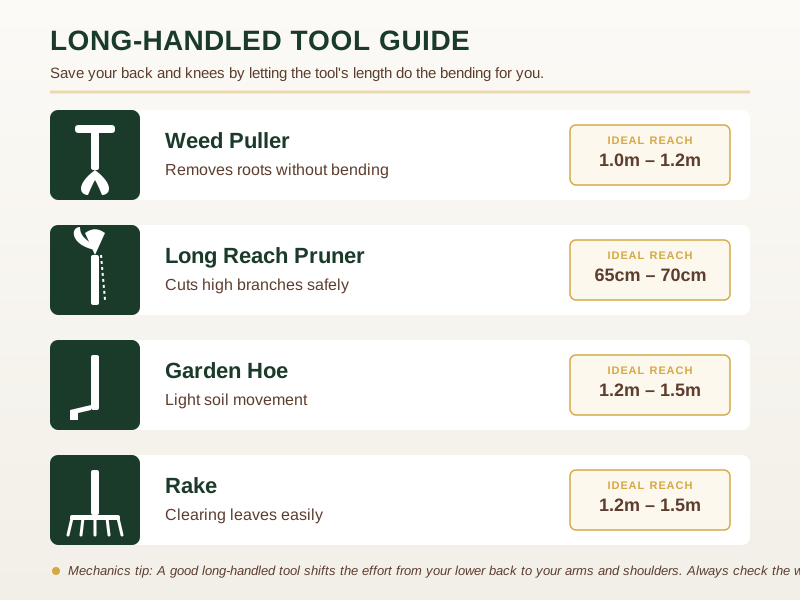
| Weed Puller | 1.0m – 1.2m | Removes roots without bending |
| Long Reach Pruner | 65cm – 70cm | Cuts high branches safely |
| Garden Hoe | 1.2m – 1.5m | Light soil movement |
| Multi-Star Set | 1.4m | Modular digging and raking |
| Trowel (System) | 1.4m | Upright planting depth |
| Rake | 1.2m – 1.5m | Clearing leaves easily |
| Fork (System) | 1.4m | Aeration without stooping |
Frequently Asked Questions
How long should a garden tool handle be for a bad back?
For most garden beds, a handle between 1.2m and 1.5m offers enough reach to keep you standing upright while still allowing precise control. Anything longer than that tends to feel unwieldy and might actually force you to over-reach, which puts the strain right back onto your spine.
Are ratchet secateurs really worth the extra cost?
Yes, absolutely, if you struggle with grip strength or hand fatigue. A ratchet mechanism divides the cutting force over three or four light squeezes instead of one hard one, which takes the pressure off your joints. The premium price pays off very quickly if you have a lot of woody pruning to get through.
What maintenance do long-handled tools need?
Keep the metal shafts clean and dry to prevent rust – a quick wipe down with an oily rag after use does the trick perfectly. Check any plastic joints or bolts every few months and tighten them up, and keep an eye on soft-grip covers, as they can become slippery in wet weather once the rubber starts to degrade.
Can I use a long-handled tool on a small patio garden?
You certainly can, and they are often brilliant for it. The extended reach means you can work from the centre of the patio without constantly bending over the edges of low pots or containers. Just be mindful of the tool’s swing radius so you do not accidentally knock over your other plants.
Should I buy a budget or premium long-handled tool?
The mechanism matters more than the price bracket, but budget does still play a part. If you are only out there for a couple of hours a week, a well-made budget option with a decent claw or grip will serve you just fine. But if you are out daily or doing heavy-duty clearing, spending the extra £20 on a premium model usually buys you a sturdier mechanism and a tool that will not snap under pressure.
Related Guides
For a complete overview, see our Gardening with a Bad Back: Tools to Stop Bending and Strain.
Where These Numbers Came From
- Thrive - Upright gardening advice for accessibility.
- Arthritis Action - Joint fatigue and mechanical advantage.
- Arthritis UK - Condition-specific advice.
Prices quoted above are approximate and were checked against current UK retailer listings at the time of writing – they will drift, so treat them as a guide rather than a quote. As an Amazon Associate I earn from qualifying purchases, and the products linked above are ones I would use or recommend in my own garden. This is general guidance rather than professional advice, so if you have a specific medical condition affecting how you move, it’s worth checking with a GP or occupational therapist before committing to a routine built around any of these tools.
Check Fiskars PowerGear secateurs price → (paid link)
Buy Fiskars Xact weed puller on Amazon → (paid link)