Motorised Wheelbarrows & Carts: Pain-Free UK Lifting
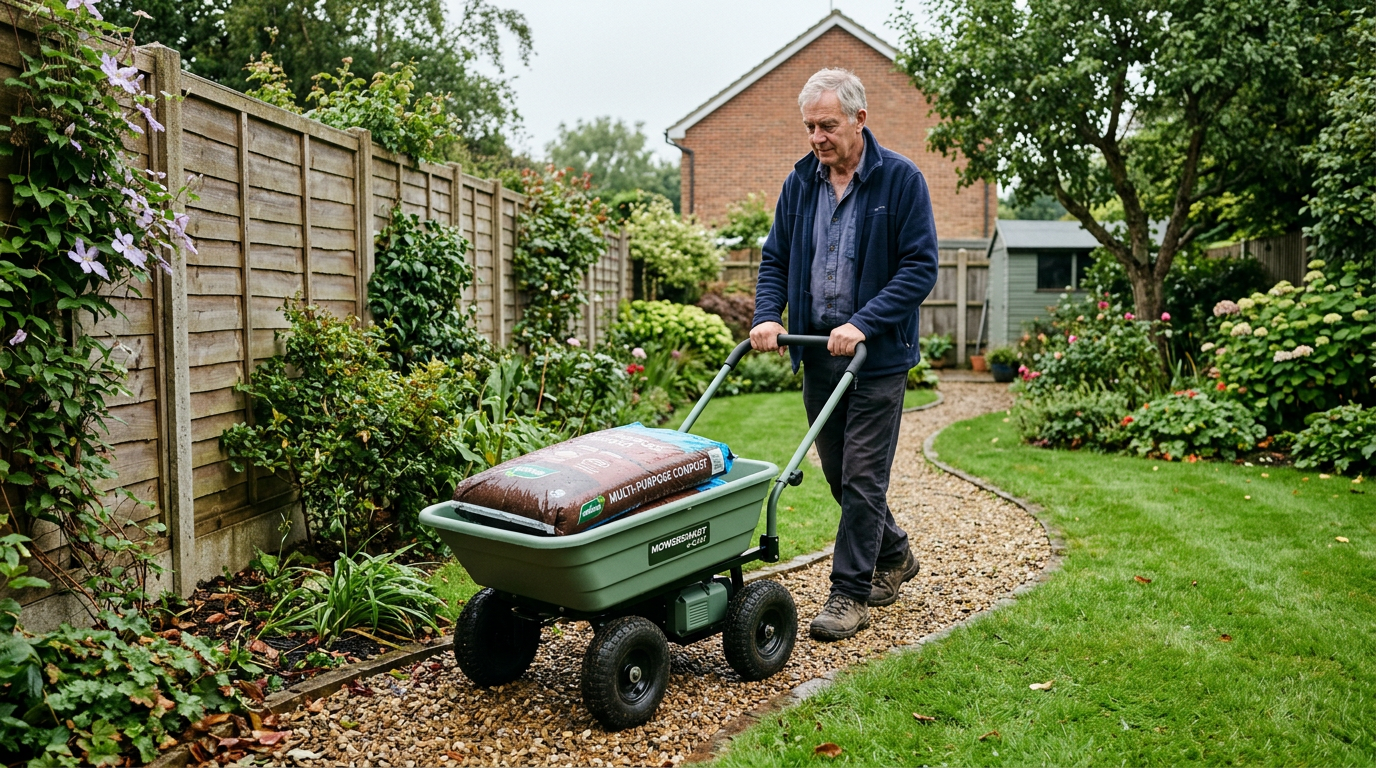
Search “motorised wheelbarrow UK” and the results aren’t quite what you’d expect. Most of what comes up isn’t a neat little garden cart at all – it’s a heavy-duty power barrow built for shifting rubble on a building site, not compost round a flower bed. That’s worth knowing before you shop, because it shapes what’s genuinely on offer. As I mention on my about page, a wonky, wrist-jarring barrow was what pushed me to look properly at the alternatives. The right motorised cart changes the mechanics entirely: it does the heavy lifting for you, letting you steer and guide rather than bend and hoist, taking the strain off your spine and keeping you gardening without paying for it the next day.
Why Does a Standard Wheelbarrow Hurt Your Back?
A standard wheelbarrow hurts your back because the classic bend-and-lift motion forces your lumbar spine to compress under a heavy load. When you lift the handles, your lower back takes the brunt of the weight, and any twist to balance the barrow adds shear force that can easily pinch a joint.
That repeated compression is the exact mechanism behind many manual handling injuries reported by the Health and Safety Executive (HSE). Add a twist to straighten the load on an uneven path, and you introduce those shear forces to the facet joints. The result is a classic garden twist injury – the kind that sends you to the physio clinic and keeps you off the compost heap for weeks.
A motorised cart changes the game: you push a low‑effort handle, the motor supplies the forward thrust, and the load stays level on a fixed platform. The spine stays upright, the twist disappears, and the load’s centre of gravity is managed by the cart’s stabilising chassis.
If you’re already using a cheap plastic barrow, you’ll recognise the warning sign: the handles dig into the wrists after just a few minutes. That’s a red flag that your grip is taking the brunt of the load, not the wheels. Switching to a self‑propelled cart removes that strain entirely.
Tip: If you’re still on the “manual only” route, consider pairing your barrow with an ergonomic kneeler to reduce the time spent bending in the first place.
Battery vs. Petrol: Which Power Source Fits a UK Garden?
For most UK gardens, a battery-powered cart is the best fit because it runs silently, emits no fumes, and can be safely stored in a shed or garage. Petrol models offer more torque for heavy loads like logs, but they are loud, require engine maintenance, and produce exhaust fumes.
Both battery‑powered and petrol‑driven carts have a place in a British garden, but the choice hinges on noise, maintenance, and the typical load you move.
Battery‑powered carts are virtually silent, emit no fumes, and can be stored indoors during the damp winter months. The downside is the need to charge – and a UK winter can slow charging rates dramatically. Keep the battery in a warm, dry loft, because a sudden downpour can leave an exposed motor sputtering and refusing to restart until it dries out.
Petrol models deliver a higher torque output, making them the go‑to for heavy logs or large soil loads. They do, however, roar louder than a neighbour’s mower, and the smell of petrol can be a bit of a faff in a small garden with close‑by windows. Regular fuel stabiliser is a must for winter storage, otherwise the fuel can congeal and damage the engine.
Conversion kits attach a small electric motor to a standard barrow. They’re a budget‑friendly compromise but add extra weight to the empty barrow, which can be a problem if you have a weak grip.
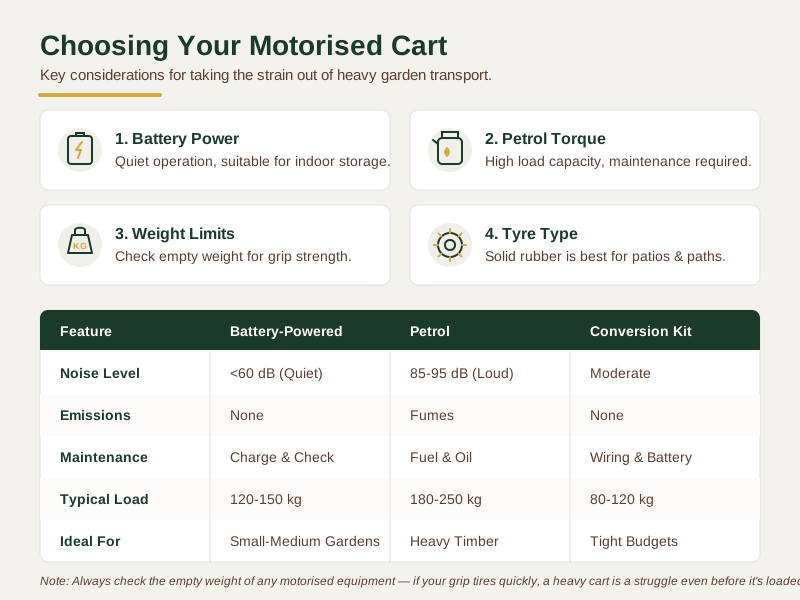
Below is a quick comparison that sums up the main trade‑offs:
| Feature | Battery‑powered | Petrol | Conversion kit |
|---|---|---|---|
| Noise level | <60 dB (quiet as a garden hose) | 85–95 dB (like a mower) | Depends on motor, usually moderate |
| Emissions | None (indoor storage fine) | Fumes, need ventilation | None |
| Maintenance | Charge, occasional battery check | Fuel, oil, spark plug | Motor wiring, battery |
| Typical load capacity | 100–365 kg (small utility carts to power barrows) | Up to around 500 kg for dedicated dumpers | Modest – limited by the host barrow and motor |
| Ideal for | Small‑to‑medium gardens, frequent use | Heavy timber, large soil moves | Tight budgets, occasional lifts |
The honest answer is: for most UK gardens the battery option is spot on – it respects noise restrictions, fits neatly in a shed, and the charging hassle is outweighed by the health benefits of a quieter, cleaner tool.
What to look for when choosing a motorised cart
A motorised cart does the work, but you still need to match it to your garden’s dimensions and your own physical limits. First, measure the narrowest gate or patio width – most UK side gates and paths sit somewhere around 700–900 mm, so a cart with a turning radius under a metre will manoeuvre without banging into flagstones. If you’re planning paths from scratch, the RHS has general guidance on garden layouts worth a look. Next, check the empty weight – aim for under 20 kg if you have wrist or grip issues; a lighter chassis means less effort when you need to nudge it by hand. Finally, assess the handle design: a soft, rubber‑coated grip with a slight angle keeps the wrist in a neutral position, reducing the load on arthritic hands.
Motorised Carts and Power Barrows You Can Actually Buy in the UK
📺 Watch: Why Everyone Wants This New EGO Power Barrow! — Machinery Nation
Snapper ESXDUC82 Self-Propelled Utility Cart
The Snapper is a genuine battery-powered option built for garden-scale jobs rather than a building site: a 300W motor, an 82V Briggs & Stratton battery (2Ah or 4Ah, sold separately), and up to 100 kg / 106 litres of capacity. A quick-release lever gives lift-assisted unloading, there are two forward speeds plus reverse, and a rear castor wheel keeps it manoeuvrable in tight corners. It even folds down a drawbar so it can be towed behind a ride-on mower.
- Pros: Purpose-built for garden loads, lift-assisted tipping, foldable drawbar for towing.
- Weak point: It’s sold as a “bare tool” – battery and charger are extra on top of the roughly £539 list price, and a heavier load or a slope will eat into the runtime faster than a flat, light one.
Muck Truck Max EGO Power Barrow
If the Snapper isn’t man enough for the job – logs, rubble, a skip’s worth of soil – this is the machine that actually turns up when you search for a UK motorised wheelbarrow, and it’s the one in the video above. It runs on a 56V EGO Power+ battery system with 4-wheel drive, ECO and Turbo modes, and a genuine 365 kg load capacity. This is a proper British-built mini dumper rather than a garden accessory: at roughly 143 kg with its batteries fitted, it’s too big for a small patio, but for an allotment, a self-build, or a larger plot it will out-haul everything else here.
- Pros: Serious load capacity, four-wheel drive stability, fast charging (around an hour for a full battery).
- Weak point: It’s genuinely heavy machinery, not a lightweight cart – overkill, and awkward to store, for a small suburban garden.
Worx Aerocart WG050 – the honest non-motorised option
Worth including even though it isn’t powered: the Aerocart’s “Turbo Lift” design uses wheel position and leverage, not a motor, to make a loaded barrow feel dramatically lighter to tip. At around 19 kg empty and roughly £150, it undercuts every motorised option here, and it’s a sensible choice if you’d rather skip batteries and charging altogether.
- Pros: Genuinely lighter to tip than a standard barrow, nothing to charge, widely stocked.
- Weak point: You still supply all the forward push yourself – it solves the lifting problem, not the pushing one.
The Snapper and Muck Truck are sold through specialist groundcare retailers and the manufacturers’ own sites rather than general DIY chains, so don’t expect to find them on a shelf at your local hardware shop. The Aerocart, being a simpler mechanical tool, is the one you’re far more likely to find at a mainstream retailer or on Amazon. Prices and stock move, so treat the figures above as a starting point rather than gospel, and check the current listing before you buy.
Ergonomic Comparison: Weight, Grip, and Safety
When you’re battling a weak grip, the feel of the handle can make or break a tool. Look for a soft‑grip rubber sleeve that widens the contact area to at least 30 mm – that spreads the force across a larger part of the hand, reducing pressure points in arthritic joints. If you need specific advice on managing joint pain while working outside, charities like Arthritis UK offer excellent practical guidance.
Weight matters too. An empty cart under 20 kg lets you reposition it without straining the wrist, while a heavier chassis can become a lifting chore if you need to move it onto a higher shelf. The Worx Aerocart, for example, weighs around 19 kg empty – on the right side of that threshold, though not by a huge margin.
Safety features are often overlooked. A reliable hand‑brake that locks the wheels prevents the cart from rolling away on a slope, and a low centre of gravity keeps it stable when the load shifts. A heavier machine like the Muck Truck’s four-wheel-drive stance naturally feels planted, but any cart running on smaller castors can wobble on uneven ground – a quick test on your own garden path will reveal whether it feels steady enough for you.
Quick ergonomic checklist:
- Handle material: rubber or soft‑moulded plastic, not hard plastic.
- Handle angle: 10‑15° upward tilt keeps the wrist neutral.
- Empty weight: aim for ≤20 kg if grip strength is limited.
- Braking system: hand‑lever or foot‑pedal lock.
If you’re already hunting for easy‑grip tools, having a browse through the reviews on our blog offers a useful comparison of handle diameters and grip materials that can be applied to cart handles as well.
How to Safely Load a Motorised Garden Cart
A motorised cart takes the strain out of pushing, but if you load it poorly, you can still easily tweak your back.
1. Park on level ground
Always engage the hand-brake and ensure the cart is on a flat surface before you start filling the bucket. This stops it from rolling away mid-shovel and keeps the load’s centre of gravity completely stable.
2. Load the heaviest items over the axle
Place heavy wet soil, paving slabs, or logs directly over the driven wheels rather than at the front lip. This gives the motor maximum traction and makes steering much lighter on your wrists.
3. Keep the load below the rim
Resist the temptation to pile compost into a towering pyramid. Keeping the weight low and flat prevents the cart from tipping sideways if one wheel drops into a dip on the garden path.
4. Let the motor start the movement
Instead of shoving the cart forward to get it going, stand upright, gently engage the throttle, and let the motor take the initial strain. Your job is just to guide the handles, not provide the push.
Maintenance and Weather in the UK
A motorised cart is an investment, and the British climate can be unforgiving if you ignore a few simple care steps.
Battery care: Store lithium‑ion packs indoors, ideally in a dry loft or shed where temperatures stay between 10 °C and 20 °C. In winter, charging can take up to 30 % longer; plugging the charger in somewhere warm, like a heated garage, for the first hour before letting it finish in a colder spot helps offset the slowdown.
Petrol upkeep: Add a fuel stabiliser to the tank before the first frosty night, and run the engine for a minute each week to keep the carburettor clean. A clogged carburettor is a common cause of “won’t start” after a wet spell.
Waterproofing: Most carts come with a basic splash guard, but a simple rubber cover over the motor housing stops rainwater from seeping in. Leaving a battery‑powered cart exposed during a downpour is a common way for the motor coupler to start corroding within weeks, and a cheap cover is far less hassle than a motor repair.
Regularly check the tyre pressure (if pneumatic) and tighten any loose bolts before each season. A quick visual inspection after a heavy rain can spot rust or water ingress early, keeping the cart road‑ready all year.
Frequently Asked Questions
Are motorised wheelbarrows worth the money?
Yes, a motorised wheelbarrow is absolutely worth the money if you struggle with back pain, sore knees, or a weak grip. They completely remove the need to bend and hoist, which means fewer aches and a much lower risk of a serious twist injury. The upfront cost is quickly offset by the fact that it keeps you actively gardening without the physical strain.
Can I use a motorised cart on a paved patio?
Yes, you can use a motorised cart on a paved patio, but you need to choose a model with the right tyres. Opt for hard‑wearing solid rubber wheels or a track system. Deeply treaded pneumatic tyres can sometimes leave marks or struggle with grip on wet flagstones, so solid rubber is usually the safest bet for delicate paving.
Do I need a driving licence for a motorised cart?
No, you do not need a driving licence for a garden cart. They are classified as garden machinery rather than road vehicles. As long as you are using them on your own private property, patio, or allotment, there are no licensing, tax, or registration requirements to worry about.
The Short Version
You’ve seen how a motorised cart can turn a painful, back‑breaking chore into a smooth, upright ride. The key takeaways are: choose a battery model for quiet, low‑maintenance work; keep the empty weight under 20 kg if grip strength is limited; and always check the handle angle and braking system for safety.
Now you know exactly what to look for – Download the Free Easier Gardening Tool Checklist to compare specs, prices, and ergonomic features side by side. It’s a quick way to keep the research you’ve done today tidy and ready for when you’re ready to buy.
If you still have questions, feel free to get in touch or pop by the comment section. Gardening should be about the joy of getting your hands in the soil, not the pain of lifting a load. With the right motorised cart, you can keep that joy alive for many seasons to come.
— Roy, your fellow gardener, still convinced the right tool makes all the difference.
Related Guides
For a complete overview, see our Tools for Gardening with Limited Mobility: Low-Effort UK Guide.
Digging Deeper
Specs, prices, and load capacities in this guide are checked against manufacturer and retailer listings rather than assumed – but stock, pricing, and specifications shift, so confirm the current figures directly with the retailer before you buy. The general safety and health guidance draws on:
- Health and Safety Executive (HSE) - Manual Handling Operations Regulations
- Royal Horticultural Society (RHS) - general garden design and pathway guidance
- Arthritis UK - Managing Symptoms in the Garden