UK Grants for Accessible Gardening Equipment: The Complete Guide
Ask three people where the money is for accessible gardening equipment and you’ll usually get three different half-right answers: “try the RHS,” “isn’t there something through Thrive?”, “ask the council.” All three names are genuine charities and schemes. Only one of them is actually built to hand an individual gardener cash for a set of ratchet secateurs or a raised bed — the other two work quite differently to how most people assume, and chasing them the wrong way can burn weeks you don’t have. This guide sorts out which route is worth your time first, what each one genuinely costs in paperwork and waiting, and where the real money for kit like ramps, lightweight tools and raised beds actually sits.
Download the Free Easier Gardening Tool Checklist to see at a glance which pieces of equipment are usually eligible for funding.
The Real Funding Landscape: GWDT, Thrive and the RHS
Start with the Gardening With Disabilities Trust (GWDT) — it’s the only one of the three built specifically to fund individual gardeners’ tools and equipment, and it’s the most direct route on this list. One important caveat to check first: as of their 8 June 2026 update, GWDT is temporarily not accepting new applications while funds replenish (the Apply button is deactivated), so check the page before you start gathering paperwork — they’ll announce the reopening date there once confirmed. GWDT gives grants toward raised beds, tools, small-scale adaptations and access ramps; individuals can apply for up to £1,000, though the average award is closer to £500. To apply you’ll need a letter from a GP or other healthcare professional confirming your condition, a supporting document such as a PIP award letter or Blue Badge, and a clear quote for the equipment. One detail matters more than anything else here: GWDT only reviews applications in two windows a year — March to May, and September to November — and applications submitted outside those windows simply aren’t considered. Miss the window and you’re waiting for the next one, so if GWDT is your best option, have the paperwork ready before the window opens rather than during it. A concise cover letter explaining, in plain terms, how the equipment keeps you gardening and tying it to your wellbeing goes a long way here — it’s a small thing that consistently makes applications easier to assess.
📺 Watch: Gardening with Illness or Disability - Tips and Tricks to Keep You Gardening — Common Ground Gardens
Equipment quality matters to an assessor. A cheap pair badged “ratchet action” that barely delivers more than a click or two per squeeze doesn’t do much for a stiff wrist, and a quote for a tool like that is more likely to be queried than approved outright. Putting a genuine multi-stage ratchet mechanism on the quote — the kind that divides a hard cut into several light squeezes rather than one — costs a little more up front, but it’s the difference between a tool that actually takes the strain off your hand and one that just has the marketing to suggest it does.
Need the right pair? Have a look through the blog for my latest secateur reviews.
Where people trip up is assuming Thrive and the RHS work the same way as GWDT. They don’t, and treating them as equivalent wastes an application.
Thrive is a genuinely excellent charity, with over 45 years’ experience in social and therapeutic horticulture — but it doesn’t run its own equipment grant fund. Its own guidance is explicit that it doesn’t offer a home-garden maintenance or grants service; instead it signposts people toward other funders, including GWDT itself, the Disabled Facilities Grant, Family Fund, and forces charities such as the Royal British Legion or SSAFA where relevant. If you’re on a Thrive therapeutic horticulture programme, staff there can be a genuinely useful advocate when you apply elsewhere — just don’t budget on Thrive paying for the kit directly.
The Royal Horticultural Society (RHS) is similar in one important way: its Community Wellbeing Grant, worth £5,000–£10,000 per award, cannot be paid to individuals at all. It’s aimed at registered charities, social enterprises, community gardens and allotment associations with their own bank account, funding projects that widen access for a group — a shared accessible allotment plot, say, rather than one person’s back garden. If you’re part of, or can partner with, a community garden or allotment association, it’s worth pursuing on their behalf. If you’re adapting your own garden solo, it simply isn’t a route open to you, however good the project.
Other Routes: Council Grants, the DFG and the Family Fund
Your local council is often the fastest route to some money, even if it’s rarely the largest amount. Two schemes usually sit under a council: Discretionary Grants and the national Disabled Facilities Grant (DFG).
📺 Watch: Disabled Facilities Grant Process — Cambs Home Improvement Agency
Discretionary Grants are small, locally-administered pots for community wellbeing projects. They’ll often cover a single item — a garden kneeler with sturdy handles to push up from, a set of ergonomic tools, or a modest raised-bed kit. Application forms are usually online, budgets are modest (often somewhere around £500, though this varies council to council), and a decision can come back in a matter of weeks.
The Disabled Facilities Grant is a government scheme, administered through your council’s social services or environmental health team, aimed at structural adaptations — a permanent path, or a raised-bed framework built into the ground. It can cover larger sums than a discretionary grant, but expect heavier paperwork and stricter eligibility thresholds. Worth knowing before you apply: a DFG typically funds a safe route to, and a level area within, the immediate garden near the home — not access to every corner of a large plot — so a full makeover of a big garden is unlikely to be covered end to end, even where a smaller access path would be.
A useful shortcut with either scheme: ring the council’s “Accessibility and Adaptations” team directly and ask for the current discretionary grant flyer. Most will email a one-page guide listing budget limits and the preferred quote format.
If you need a stool or kneeler, you can find my top picks over on the blog.
Parents and grandparents often overlook Family Fund, which supports families raising a disabled or seriously ill child or young person on a low income — and it isn’t limited to toys. Gardening equipment that gets a young person outdoors — a lightweight electric mower, an easy-grip trowel, a small raised-bed kit — is a legitimate ask. Two things worth knowing that don’t always make it into other write-ups of this charity: eligibility is means-tested (the family needs to be on a low income or receiving qualifying benefits), and the child or young person needs a demonstrable high level of support in at least three of Family Fund’s seven support-need areas, not just a diagnosis. Family Fund doesn’t publish a fixed grant range — awards are assessed against household need — so treat any specific figure you see quoted elsewhere with some caution.
Application Strategy: How to Actually Get the Money
Getting the paperwork right is where most people trip up. Below is a step-by-step plan that works for most of the grants above.
📺 Watch: How To Apply For Charity Grant Funding — Charity Excellence Framework
Gather the medical basics and quotes A recent GP letter confirming the mechanical limitation — grip strength, back pain, arthritis — is essential for most applications. Take clear photos of the garden area you want to adapt, and gather at least two quotes from reputable suppliers; a third quote, where you can get one, shows you’ve shopped around and gives the assessor a realistic price range.
Time your application for the right season Avoid applying in the dead of winter unless the grant is specifically for indoor or greenhouse projects. Most charities process faster in spring and early summer, when demand for outdoor adaptations naturally rises. Getting paperwork in early gives the funding a chance of landing before the growing season is over.
Budget for a one-off, complete cost Most grants are a single payment, not a recurring allowance, so budget the full cost — equipment, delivery, VAT — in one go. Leave a £40 heavy-freight charge off a timber raised-bed quote and that’s a bill you’ll be covering yourself.
Mention any DIY assembly you can manage If you or a family member can assemble the item rather than paying a contractor, say so — it keeps the total down, which rarely hurts an application. Charities weigh this differently, so treat it as a sensible cost-saving mention rather than a guaranteed advantage.
Check the form before you send it Include itemised quotes that break down labour, materials and delivery separately — a vague quote is one of the most common reasons applications get bounced back for more information — and check for a signature or declaration section before you submit. A missing signature is an easy, avoidable delay.
The paperwork can feel like a faff, but a well-prepared file cuts the waiting time dramatically. A concise, one-page application with clear, itemised quotes attached gets a faster reply than a scattered one almost every time.
The Order I’d Apply In
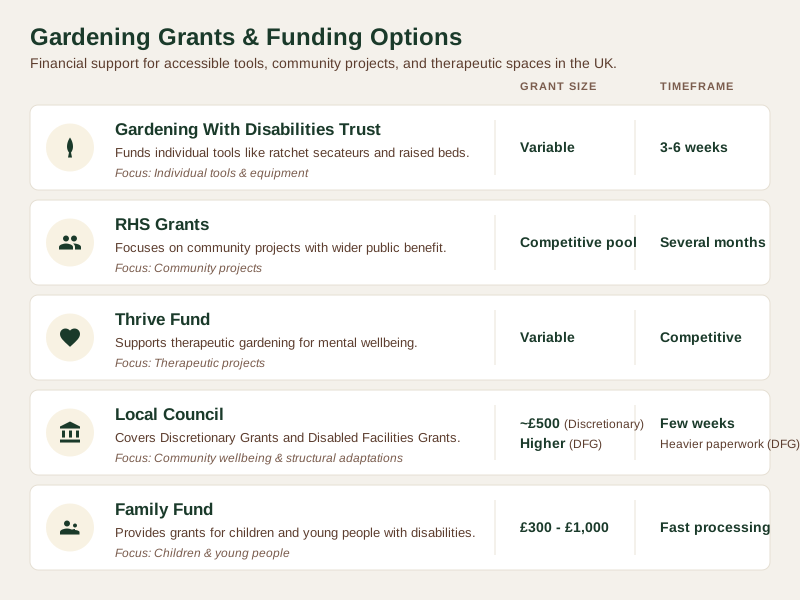
Weighing these up isn’t really about which charity is “best” — it’s about which one is worth your limited time first, given what it actually costs you in effort versus what it’s likely to pay out. Here’s how they compare:
| Body | Focus | Typical Grant Size | Application Timeframe | Effort to Apply |
|---|---|---|---|---|
| Gardening With Disabilities Trust | Individual tools & equipment | Up to £1,000 (avg. ~£500) | ~3 months; Mar-May or Sep-Nov windows only | Low — one form, one quote |
| Local Council (Discretionary) | Community wellbeing | Often ~£500, varies by council | A few weeks | Low — short online form |
| Family Fund | Children & young people (means-tested) | Assessed per need, not fixed | Varies | Medium — income and support-need evidence |
| Disabled Facilities Grant (DFG) | Structural adaptations, garden access area only | Higher limits | Heavier paperwork | High — full council assessment |
| RHS Community Wellbeing Grant | Groups/organisations only, not individuals | £5,000-£10,000 | Rolling; several months | High — needs a partner organisation |
| Thrive | Signposting, not direct funding | Not a funder for equipment | N/A | N/A — refers you elsewhere |
If you’re adapting your own garden and only have time to chase one thing first, make it GWDT — it’s the only body here purpose-built to fund an individual’s tools, and the paperwork is genuinely light for what it pays out. Run a council discretionary grant application in parallel; it costs almost nothing to try and pays out fast. If you’re buying for a child or grandchild, add Family Fund to that list. Save the RHS route for if you’re already working with, or can partner with, a community garden or allotment group — and treat Thrive as a place to ask for advice and referrals, not a cheque.
Download the Free Easier Gardening Tool Checklist — it walks through the typical grant criteria and helps you match your wish list to what’s fundable.
If you have questions about a specific grant, or want to read more about this site, feel free to get in touch.
Frequently Asked Questions
Do I need a doctor’s letter to apply for a grant?
Yes, most charities and local councils require a brief GP note confirming your mobility or grip limitation. It doesn’t have to be a long, detailed medical report — a single signed page stating that you struggle with bending or hand strength usually does the trick and speeds up the review process.
Can I get a grant for a lawnmower?
Yes, provided it is a lightweight, electric, or cordless model designed specifically for easy handling. Heavy petrol mowers rarely meet the “accessible equipment” criteria, but a battery-run mower that you can push without straining your shoulders is routinely funded by trusts.
Do RHS or Thrive grants go to individual gardeners?
No, not directly. The RHS Community Wellbeing Grant is paid to registered charities, social enterprises, community gardens and allotment associations — never to individuals — so adapting your own garden on your own isn’t something it covers unless you’re doing it through a group. Thrive doesn’t run an equipment grant fund at all; it’s a therapeutic horticulture charity that will point you toward other funders, including some of the ones on this list.
How long does it take to get approved?
Approval times vary a lot by route. Local council discretionary grants can come back in a few weeks. The Gardening With Disabilities Trust typically takes around three months from application to award, and only reviews applications submitted in its March-to-May or September-to-November windows — miss the window and you’re waiting for the next one. Family Fund tends to move at a similar pace, provided your income and support-need evidence is complete upfront. RHS and Thrive aren’t really an “approval time” question for an individual gardener, since neither funds individuals directly.
Related Guides
For a complete overview, see our One-Handed Gardening: Adaptive Tools and Setup Guide.
Show Your Working
The facts on charities, grants and eligibility above were checked against each organisation’s own current guidance rather than taken on trust, because getting this wrong costs a reader real time and hope. That said, grant budgets, windows and criteria do shift year to year, so treat the specifics — amounts, application windows, exact criteria — as a starting point to confirm directly with the provider before you commit time to an application.
- Thrive - therapeutic horticulture charity; signposts to other funders rather than funding equipment directly.
- Royal Horticultural Society (RHS) - Community Wellbeing Grant for community/group gardening projects, not individuals.
- Gardening With Disabilities Trust - specialist charity funding individual accessible gardening equipment.
- Family Fund - means-tested grants for families raising a disabled or seriously ill child or young person.
- GOV.UK: Disabled Facilities Grants - government scheme for structural home and garden adaptations.