How to Weed Without Bending Over (For Bad Backs & Arthritis)
As an Amazon Associate I earn from qualifying purchases. This page contains affiliate links — if you buy through them, I earn a small commission at no extra cost to you.
Most weeding advice still assumes you can kneel down, get stuck in, and pop back up again without a second thought. For plenty of gardeners that stopped being true a while ago, and weeding is often the first job to get quietly abandoned once bending becomes the problem rather than the plants. It doesn’t have to go that way. Swap the short hand trowel for tools built to work from standing, and pair them with growing spaces raised to waist height, and the job changes shape entirely – less kneeling in the dirt, more standing and levering the weed straight out.
The “No‑Bend” Technique: Using Long‑Handled Tools
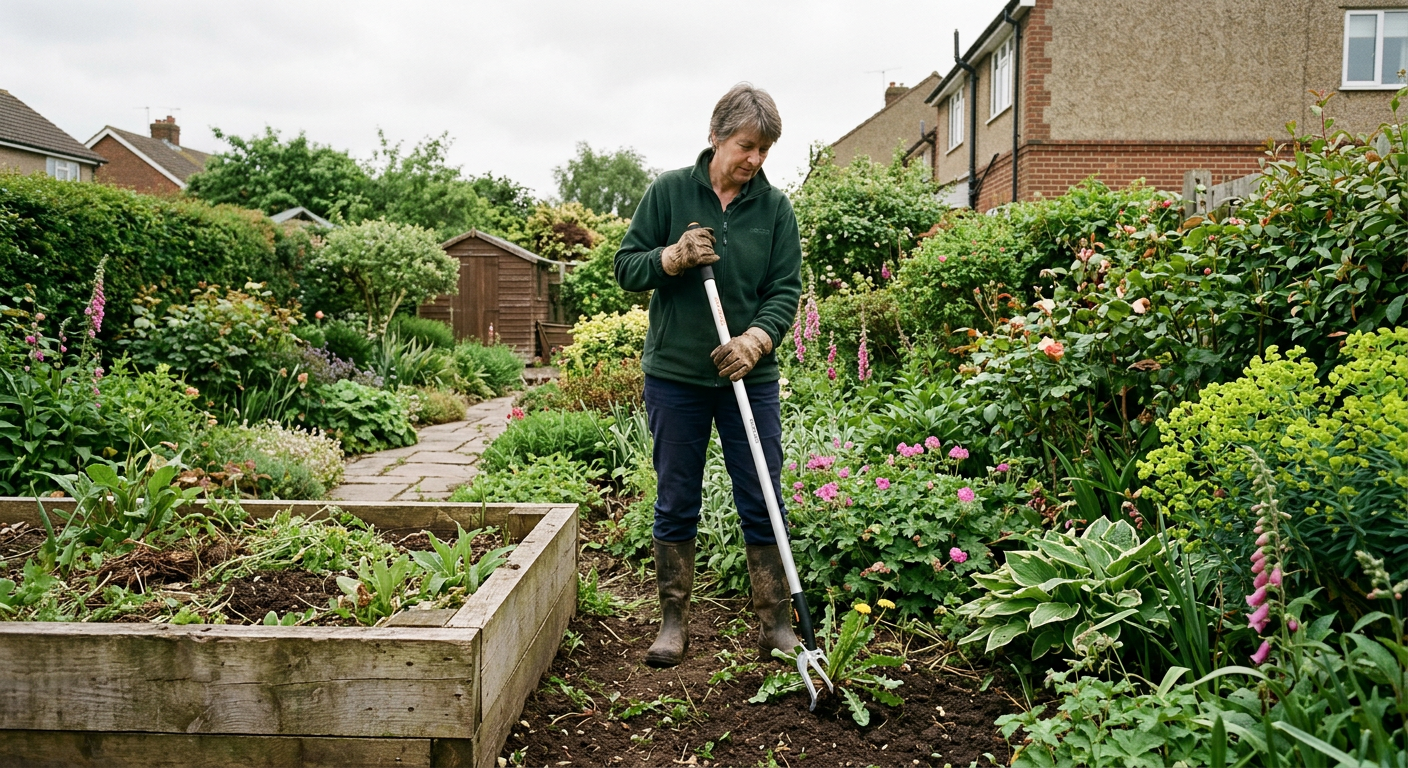
To weed without bending over, you need to replace your short hand tools with long-handled weeders that use a lever or claw mechanism, allowing you to work from a standing position. Instead of crouching and pulling with your arm, you plant the tool at the base of the weed, keep your back straight, and use your body weight to rock the handle back. This creates a fulcrum that pops the root out of the soil with minimal effort. For the best results, keep your feet shoulder-width apart and never twist your spine while pulling. If gripping a long pole is difficult, look for models with a built-in ratchet or spring-assisted trigger, which do the heavy lifting for you.
A long‑handled weeder does the hard work, but only if you use it mechanically like a lever, rather than just poking at the ground.
The Claw Method
The claw end of a weeder hooks the weed at the base. Keep the tool completely vertical, plant your feet shoulder‑width apart, and let the weight of the weed and the tool do the work. You pull straight up, using your body weight rather than arm strength.
The Lever Method
Flip the tool so the forked end rests on the ground a few centimetres away from the weed. This creates a fulcrum; push down on the handle and the weed pops out with minimal back strain.
Posture Check
Keep your back neutral, knees slightly bent, and avoid twisting. Your shoulders should stay relaxed; the effort comes from the legs and the lever action.
Do’s and Don’ts for Upright Weeding
- Do plant your feet firmly, shoulder‑width apart.
- Do keep the tool vertical when pulling.
- Don’t hunch over to get a better angle – you’ll lose the mechanical advantage.
- Don’t use a jerky motion; a smooth, steady pull is always easier on the spine.
The claw method with a regular garden fork forces exactly the hunched posture worth avoiding – ten minutes of that angle is enough to leave most backs sore. Switching to a proper long‑handled weeder and keeping the tool vertical removes that hunch entirely.
The “Stoop” Alternative: Waist‑High Gardening
If managing a long handle still feels like a stretch for a tired grip, the most practical solution is to bring the garden up to you.
Raised Beds & Planters
A waist‑high bed (around 60–80 cm tall) means you never have to bend past the knee. Soil in raised beds is generally looser, so weeds come up easier and you can pull them with a short hand fork. Charities that focus on accessible gardening, such as Thrive, often highlight raised planters because they genuinely remove the need to stoop. The honest answer is, you’ll shave a massive amount of physical effort compared with ground‑level beds.
Garden Stools & Kneelers
A sturdy garden stool lets you sit upright while you weed, and a simple kneeling mat softens the ground so you can get down for a quick close‑up without your knees taking the full impact. The Burgon & Ball Kneelo, with its neoprene cover and dense memory‑foam core, is a favourite of mine – the padding holds up even after a wet British spring, and the carry handle means it doesn’t live permanently in the shed.
Mulching
A generous layer of organic mulch suppresses weeds, meaning you’ll reach for the weeder far less often. According to the Royal Horticultural Society, a thick mulch block blocks light to weed seeds and keeps the soil moist, which is a brilliant low-effort bonus for the plants.
Swapping a low border for a VegTrug Classic (paid link) raised bed and a Town & Country EVA kneeler lets you weed from a seated position without a twinge in the knees, and a generous mulch layer noticeably cuts the weed load.
Check VegTrug Classic price → (paid link)
Now that you know the mechanics, let’s look at the tools that actually deliver on those promises.
What Are the Best Long‑Handled Weeding Tools for UK Gardeners?
The best long-handled weeding tools for UK gardeners are the Fiskars Xact weed puller (paid link) for its spring-assisted grip, and the Wolf Garten Multi-Star system for its interchangeable heads and upright leverage. Both tools allow you to remove deep-rooted weeds from a standing position without bending your back, though they suit slightly different soil types.
Buy Fiskars Xact weed puller on Amazon → (paid link)
📺 Watch: What is the best weed puller for you? Grootpow vs Fiskars comparison and demonstration.
Fiskars Xact Weed Puller
The Xact’s angled head slides under weeds like a tiny shovel: you press the foot pedal to drive the claws in, then pull up so the spring‑assisted head pops the weed loose and clear of the hole, without needing much hand-gripping at all. The grip is rubberised and stays firm even when the air turns chilly – which matters especially on a damp March morning when cold fingers lose feeling fast. The downside is the plastic cradle can crack on very rocky soil, so it’s best for well‑prepared beds.
Wolf Garten Multi‑Star
This system uses interchangeable heads that click onto a telescopic pole. The steel construction feels solid, and the mechanism gives you excellent leverage, which is a godsend if you want to avoid bending. It’s not the cheapest option – a handle-and-head starter bundle typically runs £30‑£50, with further interchangeable heads to add as you need them – but the 35‑year guarantee makes it a long‑term investment. The only gripe is the pole can flex a touch when fully extended, so it’s not ideal for heavy prying work on compacted clay.
Budget Option: Walensee Weed Puller (paid link)
Buy Walensee Weed Puller on Amazon → (paid link)
If you’re watching the pound, the Walensee offers a lightweight aluminium shaft and a simple stainless‑steel claw for roughly £30‑£40. It does the job in soft soil, but the plastic grip is narrow and can slip if your hands are sweaty. Expect to use a bit more force, which may be noticeable if your grip tires quickly.
Budget Note – The Walensee is honest about its limits; it won’t survive a rocky patch, but for a small herb border on a loamy garden it’s a sensible, lightweight starter.
Best Raised Beds & Kneelers for Pain‑Free Gardening
📺 Watch: Ergonomic Gardening Tips for Arthritis Patients — Johns Hopkins Rheumatology
VegTrug Classic
These timber‑framed beds sit at waist height and come with a drainage layer built in. Assembly is straightforward flat‑pack work, no power tools needed, and the finished unit feels sturdy enough to hold a full summer’s worth of vegetables. You’ll need to fill it with a good quality potting mix, which adds to the initial outlay – the largest (1.8m) VegTrug Classic runs to around £200‑£220 on its own, before soil. The trade‑off is the extra weight of the soil; you’ll definitely need a wheelbarrow or a garden trolley for the first fill.
Burgon & Ball Kneelo
The Kneelo’s neoprene cover and dense foam core protect knees from cold, damp ground far better than kneeling straight onto soil, and at 52cm long there’s enough pad to shift your weight without your knee finding the edge. It folds flat with a simple carry handle for the shed. It’s not cheap, but the foam holds its shape rather than flattening out the way a thin bargain pad does within a season.
Budget Option: Draper EVA Foam Kneeler
This EVA foam kneeling pad is water-resistant and comes with a carry handle, and folds flat for the shed. If you only need occasional kneeling, it does what it says on the tin.
Budget Note – The Draper kneeler works well for light use, but for anyone spending more than an hour a day weeding, the Kneelo’s thicker, longer‑lasting padding is easily worth the extra spend.
Frequently Asked Questions
Can I use a standard long‑handled hoe for weeding?
Yes, provided you use a shallow scraping motion rather than digging in. The hoe’s blade should simply skim the surface to cut weed roots, which removes the need to bend deep into the soil. Just keep the blade sharp, otherwise you end up pushing the soil around rather than slicing the weeds.
What if I have a really weak grip?
If your hands tire quickly, look for tools that do the mechanical work for you, like weeders with a spring-release trigger or lightweight aluminium handles. If your grip issues are tied to a specific condition like arthritis, it is always worth checking the practical guides from Arthritis UK for wider advice on managing the physical side of things alongside your garden adaptations.
Is it better to use chemicals or tools?
Tools are generally far better for your soil structure and keep you moving in a productive way. If you do have to resort to a weedkiller for something stubborn, opt for a targeted spot‑treatment gel rather than a heavy blanket spray – it reduces the amount of weight you have to carry around the garden and limits the environmental impact.
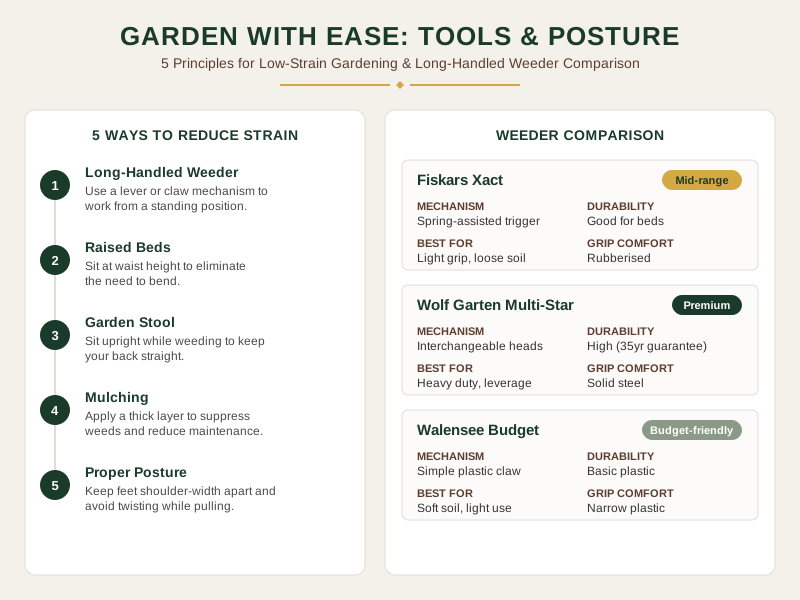
Tool Comparison for Upright Weeding
| Feature | Fiskars Xact | Wolf Garten Multi-Star | Walensee Budget |
|---|---|---|---|
| Mechanism | Foot-pedal, spring-assisted | Interchangeable heads | Simple stainless-steel claw |
| Best For | Light grip, loose soil | Heavy duty, leverage | Soft soil, light use |
| Price Range | Mid-range | Premium | Budget-friendly |
| Durability | Good for beds | High (35yr guarantee) | Basic plastic |
| Grip Comfort | Rubberised | Solid steel | Narrow plastic |
What to Look For Before You Buy
You’ve seen how standing upright, using a proper lever technique, and raising your growing area can keep the back from screaming every time a dandelion pops up. The tool suggestions give you a practical starting point, and the raised‑bed ideas let you redesign the garden so the soil stays at a comfortable waist height.
Now you know what to look for – the grip diameter, the lever action, the physical height – so you can pick gear that genuinely takes the strain out of the job. Ready to sort your kit? Check out the rest of the blog for more tool reviews before you head to your favourite garden centre.
If you have any lingering questions, want to know more about this site, or just fancy a quick chat about how to adapt a specific garden space, feel free to get in touch. Happy weeding!
Related Guides
For a complete overview, see our Gardening with a Bad Back: Tools to Stop Bending and Strain.
Who Backs This Up
None of this is guesswork. The mulching advice leans on the Royal Horticultural Society’s own guidance on suppressing weeds and retaining soil moisture, the accessible-gardening angle draws on Thrive, the UK charity that’s spent decades adapting gardens for disabled and less mobile gardeners, and anything specific to joint pain or grip strength is worth cross-checking against Arthritis UK’s own practical guides, since your hands and knees won’t necessarily behave like anyone else’s case study.
As an Amazon Associate I earn from qualifying purchases. The products linked above are ones I would use or recommend in my own garden. Product specs and prices change, so it’s worth double-checking the current listing before you buy – and if a technique doesn’t feel right for your own back or joints, trust that over anything written here.